Four Centuries of Language, Power, and Creation in THE KING JAMES BIBLE PLAY
What happens when the people shaping history are just as complicated, opinionated, and fallible as everyone else? The King James Bible Play (Playwrights Canada Press) shifts between two rooms separated by four centuries, discovering surprising connections in the messy, collaborative work that comes with deciding which words will endure.
In the early 1600s, scholars and clergymen have been tasked with producing a new English Bible for King James, bringing their own rivalries, convictions, and personalities to a translation that will profoundly influence the centuries ahead. In the present, an all-female theatre company is trying to make a play about those men, and questioning the authority, assumptions, and omissions they have inherited along the way. Charlotte Corbeil-Coleman uses that contrast to explore translation in a much broader sense, including the ways we translate history, faith, gender, family, and one another. The play had its world premiere at the Stratford Festival in August 2026.
Witty, ambitious, and alive to the strange ways the past keeps turning up in the present, the play treats history as something continually interpreted rather than simply received. In our interview with the author, Corbeil-Coleman talks with Open Book about the collective creation that first inspired the play, why she wanted its past and present stories to exist side by side, and what writing about the King James Bible revealed to her about creation, collaboration, and inheritance.
Read on to find out more!
Open Book:
How did this play first come to life for you? Do you remember the first bit of writing you did for it?
Charlotte Corbeil-Coleman:
A mentor and friend Linda Griffiths told me about a book called ‘God’s Secretaries’ by Adam Nicolson about how this collective of male translators worked on the “King James Bible” I read it and got incredibly interested in what it means to work on something collectively. I grew up in the theatre and have been a part of so many collective creations. So I immediately knew I wanted two halves to this story. Then men translating the bible and women putting on a play about men translating the bible.
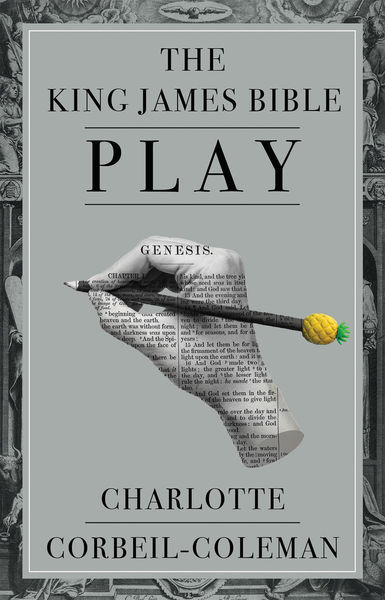
The King James Bible Play by Charlotte Corbeil-Coleman
OB:
Was there a question you were exploring in this work, and if so, did you know what it was when you started writing?
CCC:
Because of the structure of the play, the question I was always asking myself is why is this play structured this way and eventually it revealed itself to me. Because it was about the Bible I also felt it really important to offer something real and brave.
OB:
What was the most surprising or memorable moment or experience you had while writing this play?
Your CanLit News
Subscribe to Open Book’s newsletter to get local book events, literary content, writing tips, and more in your inbox
CCC:
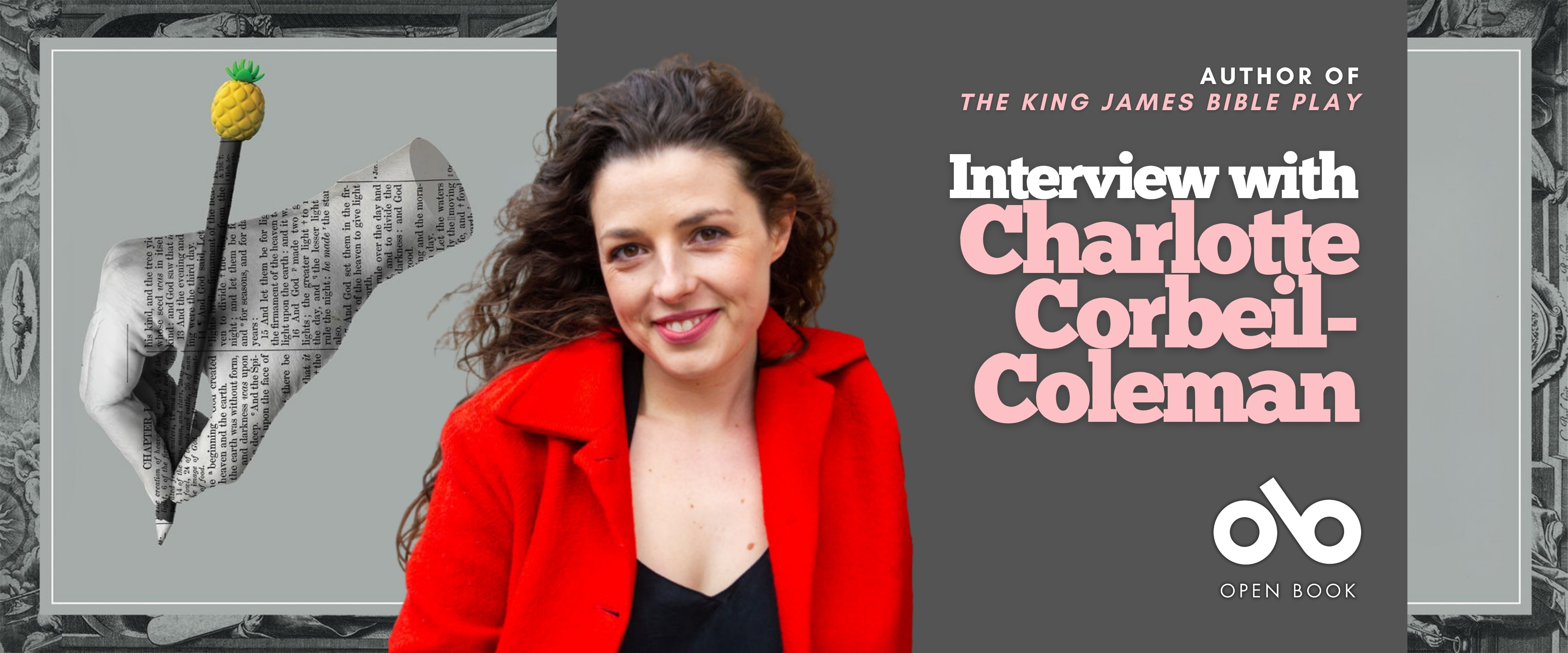
I pitched this play to Stratford based on an idea and they wanted a draft then panicked cause I wasn’t sure how I was possibly going to write it. Then I had an image of all these clergy men looking at a pineapple and reacting to never having seen it before and I knew I could write this play.
OB:
Did the script change in any way once you were rehearsing?
CCC:
Yes and no. The core story stayed the same but I made so many small changes that I believe made it much stronger. You realize the director, the actors, and the designers bring so much to your story telling you have to leave space for them. And I was so lucky to be able to make changes throughout the previews because in theatre you don’t really know what you have until it’s in front of an audience.
OB:
In your opinion, how does one go about writing great and memorable characters for the stage?
CCC:
Make them unabashedly human. Love them, that doesn’t mean they have to be good people, but I think you have to love them into being.

Charlotte Corbeil-Coleman
OB:
Are there other playwrights that you’ve been inspired by? What qualities in their work are you most drawn to?
CCC:
Branden Jacobs Jenkins is my favourite playwright. I love his wild theatricality. I love how he plays with the past and present. I feel so alive when I watch his work.
Michael Healy’s Drawer Boy and Andrew Moodie’s Riot changed my life.
I sat in on almost every rehearsal as a child of Riot and it was the first time I understood the power of a story set in the city you live in.
Similarly with Drawer Boy, I watched this show probably close to a hundred times. My father produced it at TPM and my father directed a tour of it in Saskatchewan when I was a teenager. I feel like it’s in my DNA. The humour and heart in that play and the idea of performance and what a story can and can’t do is something I am always investigating in my own writing.
OB:
Do you feel your work has changed in any way through your writing life and career? If so, how?
CCC:
Yes and no. I started writing from a very personal place, telling my own story. My mother died at fifteen and I wrote a play about it. What’s changed is I have learned to inhabit worlds outside of my story. What hasn’t changed is that it is always personal.
____________________________________
Charlotte Corbeil-Coleman is a Governor General’s Literary Award–nominated playwright and winner of the Dora Mavor Moore Award, the Herman Voaden National Playwriting Competition, and the K.M. Hunter Artist Award. She graduated from the playwriting program at the National Theatre School and writes for theatre, radio, film, and television. Her writing includes The End of Pretending with Emily Sugerman, Twisted with Joseph Jomo Pierre, Scratch, and Sudden Death. She directed and co-created Highway 63: The Fort Mac Show and wrote for CBC Radio’s Afghanada and for the TV series King. Currently she is developing two new musicals. She lives in Toronto.