Hollary Ghadery's New Novel Explores How We Find and Keep Connections When Everything is Unravelling
We're very excited to share another special preview interview for one of our featured Winter/Spring 2026 titles. Today we're sharing an enlightening Long Story Novelist Interview with Hollay Ghadery, the author of The Unravelling of Ou (Palimpsest Press).
This tender, offbeat novel centres on Minoo, a woman at a turning point in her life. On the day her granddaughter is born, joy turns into crisis when her family demands she let go of Ecology Paul (the sock puppet who has long been her closest companion) or risk losing the people she loves.
As Minoo drives home from the hospital, the puppet recounts the story of how they came to be together. Through memories of a teenage pregnancy in Iran, exile to Canada, questions of identity and desire, and years of loneliness, the book traces how imagination has become a form of survival. With warmth, humour, and emotional clarity, the novel explores attachment, self-protection, and the difficult work of choosing connection over what once kept you whole. It is a quietly daring novel about imagination, dependence, and what it takes to remain connected to the people we love when the stories that once sustained us begin to unravel.
Check out our interview with Hollay right here!
Open Book:
Do you remember how you first started this novel or the very first bit of writing you did for it?
Hollay Ghadery:
When my flash fiction collection, Widow Fantasies, was picked up by Gordon Hill Press, someone at the press made a passing (and ultimately, complimentary) comment about being curious about what I could do with a longer form of prose. I took that as the direct challenge it was probably never intended to be and proceeded to go about writing a novel. I had no idea what I was going to write at first but followed the dictum of pursuing what obsesses me. At the time, I was doing a lot of thinking about the ways in which women uphold the patriarchy. I was also thinking about absurdity, and how it has often acted as a clarifying agent for me. I live with chronic pain, anxiety, and OCD, and can often become consumed with worry. What matters? What doesn’t? Will anything ever feel alright again? Was anything ever really all right? It can be hard to tell. But by putting everything on the same absurd footing, what doesn’t matter often makes itself clear.
Around the time I started thinking about my novel, I was also reading Old Woman at Play by Adele Wiseman, which is a beautiful memoir on creativity and her mother’s prolific doll-making. Being a mom of four kids, I have made my fair share of simple dolls and crafts—sock puppets included. I can’t remember exactly when or how, but one day a sweet and slightly squeaky-voiced sock puppet meandered into my head and didn’t leave. And didn’t shut up.
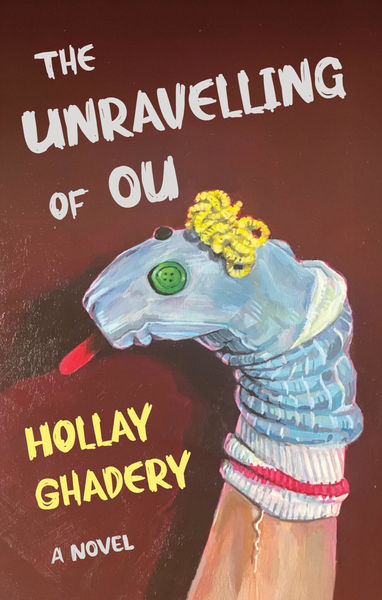
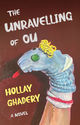
The Unravelling of Ou by Hollay Ghadery
OB:
Did the ending of your novel change at all through your drafts? If so, how?
HG:
The ending of my novel was always the ending. In fact, knowing the ending ultimately helped me write the intervening pages because I knew where I wanted to go, even if I didn’t know how I was going to get there. And I really didn’t know. After I spent a few weeks struggling to advance the story, my dear friend (and one of my favourite writers), Lucy E.M. Black, suggested I write an outline to help guide me. I scoffed at the idea. I will always consider myself a poet first, and the very idea of an outline stood in gross opposition to the intuitive poetic practice.
Your CanLit News
Subscribe to Open Book’s newsletter to get local book events, literary content, writing tips, and more in your inbox
But here’s the thing—I also write poetry slowly. Out of the four books I have published and the two slotted for release in the next couple of years, only one has been poetry (unless you count my chapbook, which came out in 2025). Though I am working on poems almost constantly, it takes me years to finish enough poems for a collection—and I really wanted to finish my novel in a year or less. Unlike the relatively compartmentalized nature of poetry, flash fiction, or personal essays, I found the novel and the world contained in it consumed me. It bled into my daily life and was taking me away from the people I love.
I remember realizing at one point that I couldn’t recall the last time I had truly looked into my children’s eyes—consumed as I was by the world of the novel. I knew I needed to get this story out as soon as possible. Considering Lucy has written a number of novels, I decided to try it her way. I scratched out a few notes on each chapter and what needed to happen in broad strokes to get me to the end I had in mind—an end that was more of a feeling than a fully realized vision. It worked.
OB:
Did you find yourself having a “favourite” amongst your characters? If so, who was it and why?
HG:
Ecology Paul, the sock puppet, is a favourite character, though I do like them all. I think Ecology Paul embodies many of the qualities I aspire to have myself. Most notably, EP is never cruel. Careless, yes, and a little flighty at times, but EP has a good heart and is kind. I like to think I am not cruel, but I have to work hard at that, and I’m not sure kindness always wins—I have some truly mean impulses I have to temper. It’s not that EP doesn’t need to recalibrate sometimes and be thoughtful about responses, but there is no massive internal struggle.
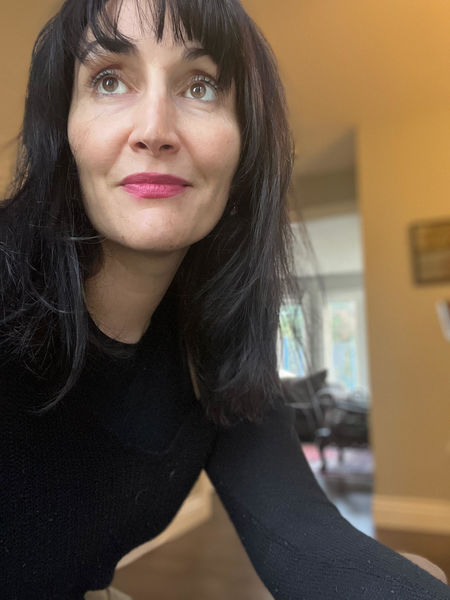
Hollay Ghadery
OB:
Who did you dedicate your novel to, and why?
HG:
I dedicated this novel to Ecology Paul, the puppet. I have dedicated books to my family before, but dedicating the book to EP felt like dedicating it to the hope I hold for the world—that it might still become a better place yet. My dedication feels a little like a wish, I suppose.
OB:
What, if anything, did you learn from writing this novel?
HG:
The most important lesson I learned while writing The Unravelling of Ou reinforced something I only held loosely before: writing is work, like all other work. If I wait for a residency, or time alone, or to feel ready, or for Aries to be in Aquarius (I don’t even know if that’s a thing), then writing anything will be slow going—or won’t happen at all. I refuse to wish my life away waiting for an ideal moment. I want to be present in every moment as much as possible, and that means taking control over as many moments as I can. There is enough I don’t have control over anyway.
_________________________________________
Hollay Ghadery is a multi-genre writer living in Ontario on Anishinaabe land. She has her MFA in Creative Writing from the University of Guelph. Fuse, her memoir of mixed-race identity and mental health, was released by Guernica Editions in 2021 and won the 2023 Canadian Bookclub Award for Nonfiction/Memoir. Her collection of poetry, Rebellion Box was released by Radiant Press in 2023, and her collection of short fiction, Widow Fantasies, was released with Gordon Hill Press in fall 2024 and was longlisted for the Toronto Book Award. Her debut novel, The Unraveling of Ou, is due out with Palimpsest Press in 2026. Hollay is a host on The New Books Network, as well as a co-host on HOWL on CIUT 89.5 FM. She is also the Poet Laureate of Scugog Township. Learn more about Hollay at www.hollayghadery.com.