Panels & Pencils with Dian Day and Amanda White, Creators of SHY CAT AND THE STUFF-THE-BUS CHALLENGE
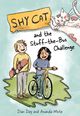
Friendship, food, and misunderstandings abound in Shy Cat and the Stuff-the-Bus Challenge (Second Story Press), a lively graphic novel by Dian Day and Amanda White about two kids learning to see each other more clearly.
Best friends Mila and Kit spend their days at the skate park, playing games, and looking after neighbourhood cats. Mila fills her sketchbook with Shy Cat comics. Kit, more often than not, is thinking about snacks. When Kit has a meltdown at school over a bag of apples and a dented can during a Stuff-the-Bus food drive, Mila begins to reconsider what she thought she understood about her friend.
As the school works to collect donations, small details take on new meaning. Told with warmth and humour, Shy Cat and the Stuff-the-Bus Challenge explores food insecurity from a child’s perspective, showing how empathy can grow when assumptions are set aside and friends learn to listen.
We're very excited to share this Panels & Pencils Graphic Novel interview with both the author and illustrator of this wonderful new title!
Open Book:
Tell us about your new book and how it came to be.
Dian Day & Amanda White:
Shy Cat and the Stuff-the-Bus Challenge is about best friends Mila and Kit. At its heart, it’s a story about friendship, but it also explores some of the harder questions kids begin to ask in their pre-teen years about how the world works. Kit is dealing with food insecurity, and Mila wants to understand why food isn’t fair. Mila tries to work through these questions in her Shy Cat comics, but she discovers that making things fair in the real world is far more complicated.
It’s a difficult subject, but we worked hard to make it accessible and engaging. There’s humour woven throughout, and we hope readers will smile as well as think.
The book came about because we were invited to create it. About five years ago, a small group of academics with backgrounds in dietetics and food studies approached us about developing a resource for children. We formed what we now call the Hungry Stories team and began meeting online every couple of months. Before shaping the book, we conducted extensive research—both academic research and a broad survey of what already existed for kids on the topic of food insecurity.
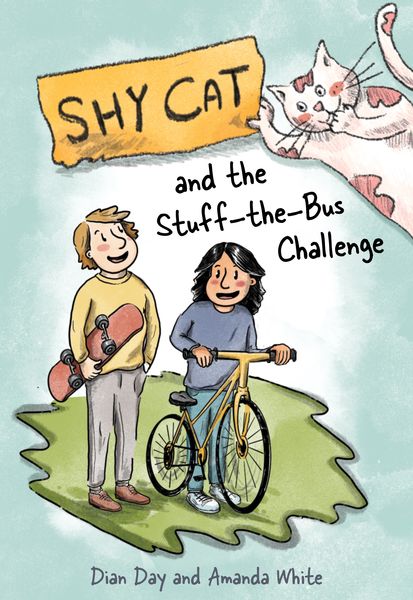
Shy Cat and the Stuff-the-Bus Challenge
OB:
Is there something you hope readers get from reading your book or a subject you hope to bring more attention to that is contained in your story?
Your CanLit News
Subscribe to Open Book’s newsletter to get local book events, literary content, writing tips, and more in your inbox
DD & AW:
The book grew out of a recognition that if we wanted a certain kind of story about poverty and food insecurity to share with our own kids and grandkids, we were going to have to create it ourselves. If children aren’t given accurate information about these issues—or encouraged to think about them deeply—we won’t be able to address them effectively as a society.
Too often, stories in literature, news, and social media frame poverty and food insecurity as individual problems with individual solutions. That framing can lead kids, whether they’re experiencing poverty or not, to see food banks and community supports as sites of shame. We don’t want a world where food banks exist simply because we haven’t figured out how to ensure everyone has enough to eat—but at the same time, no one should ever feel shame for accessing them. Food insecurity is not a personal failure; it’s a societal one, especially for people who have been historically marginalized.
Ideally, we want to help kids—who will grow into adults—ask thoughtful, informed questions about poverty, food systems, and fairness. Research shows that the real solution to food insecurity is income-based, not charity-based, and that’s an important distinction to understand.
OB:
How do you see your artwork and your text working with and informing each other in this project?
DD & AW:
Dian initially began by sketching the book rather than writing a traditional script—we didn’t even know comic scripts were a thing until we took an online comics course together at OCAD University. Dian had to learn to let go of her early sketched images and trust Amanda’s artistic vision to shape the final visuals.
There was constant back-and-forth at a micro level about how text and image interacted. We probably spent as much time discussing ideas and concerns as we did writing, rewriting, drawing, and redrawing. That collaboration became one of our greatest strengths: we always had someone deeply familiar with the work who could ask, “Could this be clearer? Stronger? More effective?”
We had to determine when words and images should align and when they should deliberately contradict each other to convey emotion or meaning. At times, the process felt all-consuming—like learning a new language.
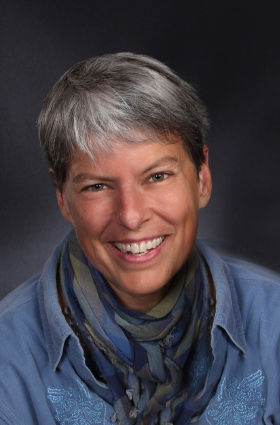
Dian Day
OB:
Do you feel like there are any misconceptions about writing graphic novels? What do you wish people knew about what you do?
DD & AW:
Making a good graphic novel is hard. Even experienced creators spend enormous amounts of time on the process. For us, this was a brand-new way of communicating. The flow, conventions, and possibilities of combining art and text are completely different from working with words or images alone.
For the writer, there’s the challenge of distilling action to its essentials and thinking visually before the images even exist. For the artist, there’s the challenge of conveying complex events and emotions through drawings that may appear deceptively simple. Practically speaking, there can be thousands of individual drawings to draft, ink, and colour.
We were fortunate to collaborate with a colourist, Jessie Zheng, whose work brought the illustrations vividly to life. That’s another misconception: graphic novels are often team efforts, with specialists in inking, colouring, lettering, and more. This book truly was collaborative at every level.
OB:
Was there a graphic novel or comic series you read as a young adult that is particularly meaningful to you?
DD:
When I was young, there were kids’ comics, superhero comics, and underground comics—but not much beyond that in my world. My parents were public school teachers, and my mother in particular had little patience for comics. Even when my own children were young, there was still debate about whether reading comics “counted” as reading.
I have my grandchildren to thank for helping me appreciate the storytelling power of the form. During the pandemic, I would take them to the library and they would sweep entire shelves of graphic novels into their bags. You couldn’t do that now—the shelves are too full! There’s been a remarkable explosion of excellent comics for readers of all ages over the past several decades, and especially in the last few years.
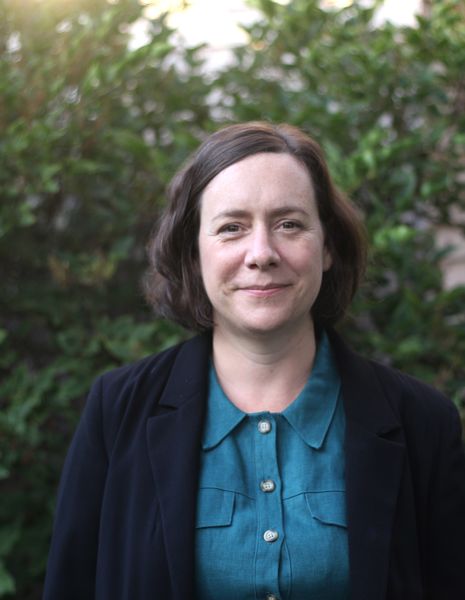
Amanda White (Photo by Brad Isaacs)
AW:
I’ve always been drawn to graphic novels as a space where image and text intersect. I tend to see them less as literature and more as a relatively new territory between language and visual art—one that’s still full of creative freedom.
About twenty years ago, I saw an exhibition at the Art Gallery of Vancouver on the alternative Comix scene and its influence on contemporary art, and that was incredibly inspiring. I also love browsing for new titles at The Beguiling in Toronto and at the Toronto Comic Arts Festival. Although I always loved reading graphic novels, I never imagined creating one. Working on this project and learning the form has been a joy.
OB:
What’s your favourite part of the life cycle of a graphic novel project? What’s the toughest part?
DD & AW:
There’s a profound sense of satisfaction when the final scene is drafted or the last thumbnail is drawn. The process is challenging—often in a rewarding way—but those milestone moments feel extraordinary. Another high point is finding a publisher who believes in the work. We couldn’t be happier with our publisher, Second Story; their enthusiasm from the very beginning made an enormous difference.
Our collaboration has also been a highlight. Working deeply with another person toward a distant goal, without any guarantee of success, is a rare and meaningful experience.
The toughest part is the time. Creating a graphic novel takes a long time, and then there’s the additional wait to find a publisher and see the book through to publication. But that time also allowed us to clarify our message and strengthen our decisions.
OB:
What are you working on next?
DD & AW:
We’re currently working on Book II of Shy Cat! We’re thrilled that Second Story is interested in continuing the series. Stay tuned.
_________________________________
Dian Day is an award-winning writer, with two novels for adults, The Clock of Heaven and The Madrigal. She is a member of the Hungry Stories Team, a cross-Canada collaboration of food scholars and activists. She and her partner live in Antigonish, Nova Scotia.
Amanda White is a multi-disciplinary artist who writes, teaches, and makes art about the environment, sustainability, and climate. She is a member of the Hungry Stories Team. Originally from Toronto, she now lives in Vancouver with her family, where she is an assistant professor at Emily Carr University of Art and Design.