Playwright Keith Barker Reflects on Love, Loss, and Laughter After a Life RAISED BY WOMEN

Memory and family are brought into sharp focus in Raised by Women (Playwrights Canada Press), a new play in which a son looks back after suffering significant loss and finds that the story he needs to tell is not about the father who left, but the women who stayed.
In a series of poignant, often funny recollections, Keith Barker writes about growing up surrounded by his mother, sisters, aunties, and their circle. Their influence is practical and emotional, shaping how he learns to listen, to feel, and eventually to forgive. The tone shifts easily between humour and honesty, with moments that feel lived-in rather than polished.
At its heart, Raised by Women is a reflection on care, resilience, and what it means to be raised in a space where emotion is not hidden. It quietly pushes back against narrow ideas of masculinity, offering instead a model grounded in empathy, connection, and accountability.
Check out this interview with author, hot off the digital press in advance of the book's release on April 7th!
Open Book:
How did this play first come to life for you?
Keith Barker:
I remember my mom visiting me in Stratford and being amazed by what I do for a living. She grew up in a small town, like the ones where she raised me and my sisters, where the arts weren’t really part of everyday life and certainly not a viable career. She said, “In a million years, I could not have imagined you would get to where you are now.”
That moment stayed with me. It made me reflect on my journey and who shaped me along the way. I realized I had been raised almost entirely by women.
My mom used to carry a note I wrote her when I first left home. She laminated it with tape and kept it in her wallet. It read: “Mom, I just wanted you to know you’re still my biggest inspiration. I love the artist in you, and it’s there I see my roots in you. You are beautiful mom. You are worth ten fathers. I don’t know where I’d be without you.”
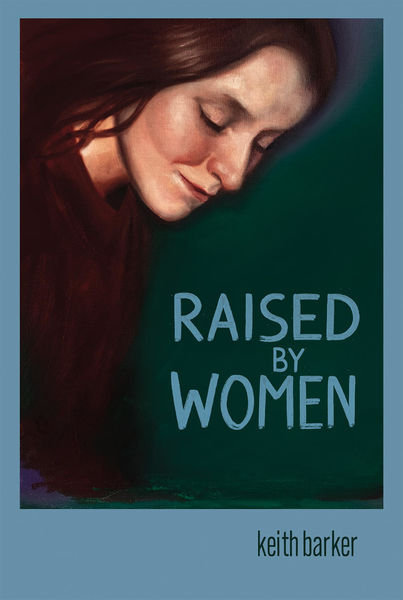
Raised by Women by Keith Barker
OB:
Do you remember the first bit of writing you did for it?
Your CanLit News
Subscribe to Open Book’s newsletter to get local book events, literary content, writing tips, and more in your inbox
KB:
I do. It was a story that always made me laugh. My mom once had to explain to me what being “on the cycle” meant. At the time, I thought I was on the cycle with her and my sisters. She gently corrected me, and I was absolutely devastated to learn I wasn’t part of their club.
OB:
Was there a question you were exploring in this work?
KB:
I was thinking about what it means to be raised by matriarchs, and how that shaped me differently from other boys. I wanted to understand when I first became aware of that difference, and how it influenced me both as a child and as an adult.
OB:
What drew you to the setting or structure of your play?
KB:
I’ve always been drawn to direct address in theatre, and to the way some stand-up comedians are now building narrative arcs into their sets. I wanted to explore that kind of storytelling within a play.
OB:
What was the most memorable moment during the writing process?
KB:
Sharing the work with friends and family. Many of them said they discovered things about me they hadn’t known before. It surprised me that writing these stories down revealed parts of me that hadn’t been visible, even to those closest to me.
OB:
Did the script change during rehearsals?
KB:
Absolutely. There were adjustments and cuts. Some sections needed to be tightened, and there were moments where I realized I was overexplaining. You don’t always see that until you hear the words spoken out loud.
OB:
Which character do you feel most connected to?
KB:
My mom. She is a constant presence in the play, and I feel incredibly grateful for that.
OB:
In your opinion, what makes a great stage character?
KB:
Story is character, and character is story. If you tell a strong, compelling story, the characters will naturally come to life.

Keith Barker
OB:
Do you have a community as a playwright?
KB: Yes, and it developed gradually. It often starts with admiring someone’s work, then meeting them, then being introduced to others through shared enthusiasm. Over time, those connections grow into a community. Being surrounded by people doing bold, honest work pushes you to do the same.
OB:
Are there misconceptions about being a playwright?
KB:
That it’s entirely solitary. Writing can be, but theatre itself is deeply collaborative, and that’s one of the most rewarding aspects of it.
OB:
Has your work changed over time?
KB:
Definitely. I have more confidence in my process now, and I’m less precious about it. I’m more open to feedback and to engaging in dialogue about the work.
OB:
How would you define the role of theatre in society?
KB:
Theatre asks us to be present. It’s one of the few places where we disconnect from our devices and share a live experience with others. In a world that can feel increasingly isolating, theatre brings people together and reminds us of our shared humanity.
_________________________________________
Keith Barker is a Métis artist from Northwestern Ontario and the former artistic director at Native Earth Performing Arts. Currently he is Director of the Foerster Bernstein New Play Development Program at the Stratford Festival. In 2023 Keith was a recipient of the Johanna Metcalf Prize and in 2020 he received a Dora Mavor Moore Award for Outstanding New Play and the Playwrights Guild of Canada’s Carol Bolt Award. Keith was a finalist for the Governor General's Literary Award for Drama in 2018 for This Is How We Got Here. He received a Saskatchewan and Area Theatre Award for Achievement in Playwriting for The Hours That Remain, as well as a Yukon Arts Award for Best Art for Social Change. Keith returned to the stage in 2023, playing Louis Riel in Frances Koncan's Women of the Fur Trade for the Stratford Festival. Other acting credits include Richard Hannay in Bruce County Playhouse's The 39 Steps, Cornwall in the National Arts Centre's production of King Lear, Roger Hughes in Seeds, and Bernard Smoke in Fury at the Blyth Festival. In 2025 Keith directed The Art of War by Yvette Nolan for the Stratford Festival.