Read an Excerpt from A HUNGRY FIRE, the New Modern Epic Novel by Élyssa Marcoux-Bissoondath
A centuries-old story finds a very different kind of afterlife in A Hungry Fire, where mythology becomes a way of making sense of a body that refuses to provide easy answers.
Élyssa Marcoux-Bissoondath reimagines the story of Queen Dido through a contemporary namesake, an ambitious civil engineer and artist who has lived with unexplained pelvic pain for years. As she goes through appointments, tests, medications, and a thirteen-year search for a diagnosis, the figures of Vergil’s Aeneid start to populate her medical world. Gods become protectors, doctors take on mythic roles, and a gynecologist becomes her unlikely Aeneas.
Fill with humour, anger, and invention, the novel gives its modern Dido the chance to tell a story that does not have to end on a funeral pyre. In the excerpt below, readers can get a first look at how A Hungry Fire brings epic myth into the examining room, exploring absurdity and the dynamics of power in one woman’s battle to be heard.
An Excerpt from A Hungry Fire by Élyssa Marcoux-Bissoondath
“I’m thinking of knocking through that wall there.” His hand leaves Dido’s vulva and gestures to his left. “Yeah, then we could move the computer over from the corner and have room for more files here.” He points behind her head. “Those cabinets are a waste of space.”
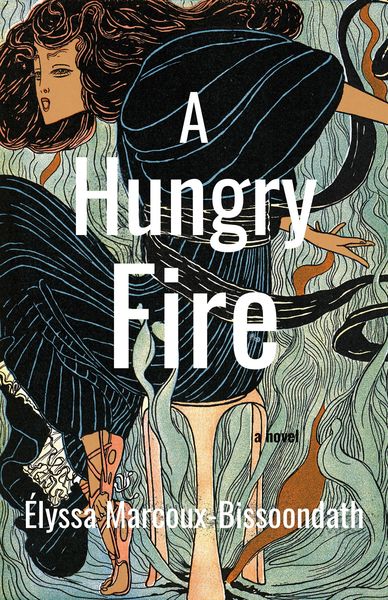
A Hungry Fire by Élyssa Marcoux-Bissoondath
The gynaecologist turns to Dido, as though politely waiting for her to nod in understanding. His youthful, somewhat mousy face splits in a toothy smile. With his thin-rimmed, rectangular glasses and short black hair he looks a little too much like a cousin of hers. Dido’s legs are beginning to shake. This always happens when they’ve been spread apart for a while, heels dug into the stirrups, the weight of her thighs unsupported by anything except the hip joints. Doctor Aeneas’s gloved hand was between Dido’s labia when his administrative assistant walked in to get a folder.
“Yeah, Sophie,” he casually called out, clearly continuing a previous conversation Dido’s vulva had rudely interrupted, “I think I’ve decided what I want to do with the computer.”
The rest of their conversation is fog to her now.
People often say: “Oh well, it’s just like any other body part to them, isn’t it? At some point it becomes like a leg or something.”
Astonishingly, that doesn’t comfort Dido. For one thing, she would have minded an unannounced human being walking in at that moment regardless of what part of her body was being prodded.
Your CanLit News
Subscribe to Open Book’s newsletter to get local book events, literary content, writing tips, and more in your inbox
It was after her third meeting with this gynaecologist that she sought me out. Calliope? My name, an incantation whispered at first then howled to the night. My ears pricked up because I usually hear men’s voices demanding my attention. Dido’s was obsidian, sharpened by pain and anger, urgently inflected. Calliope! A call for this Muse’s epic prose to bear witness to her life. I assumed she knew I normally sing of men and war. I was intrigued.
Not that she boasts about it but, over the years, Dido’s been to various clinics and hospitals and test centres in two provinces for issues with other body parts — broken foot, injured knee, sprained ankle, migraines, asthma, appendix removal, tonsil removal — and never has anyone walked in mid-appointment to be treated to a chat about office renovations. Yet, most people seem to have a similar story when it comes to gynaecologists, a tale best told around drinks in a pub with a guaranteed pinball effect of other voices adding their experiences to the laughter and shock of gathered friends.
For another thing, this is not just like a leg to her. It is intimate, it is internal, it is the Hot Gates to her chronic pain. It is a body part that makes her feel vulnerable when exposed — never mind touched — and the fact that they see ten, fifteen, twenty a day does nothing to change that. These emotions are visceral, not easily controlled.
When Dido, shivering in humid February air while on a work break, first called this eminent gynaecologist’s administrative assistant, hoping to get an appointment soon after months of waiting, Sophie had told her, “He has a grading system. You have to understand that he has cancer patients like ovarian cancer, uterine cancer, all sorts. So, he grades patients on priority like A, B, C and he’s graded you a B … I think I’ll have some room in April.”
It had taken years for Dido to convince her family doctor to make a referral because, according to her, “A gynaecologist won’t say anything new, they’ll just repeat what I’ve told you and that’s if they take you on at all.”
Dido’s consolation was that Doctor Aeneas — the best in the city — had looked at her file and confirmed her pain worthy of his time. That feeling will not survive their second appointment. By the end of her third, a year later, she will break down in tears as he holds the door open, attempting to quickly usher her out of his office and off his roster.
When she has an appointment with a new specialist, Dido is asked to recount everything from the beginning. Often, she narrates it not to the doctor but to residents with varying degrees of experience, who diligently type everything she says and ask all the questions from their script about dates and dosages, before reporting to the specialist. One such appointment kept her in the clinic for over three hours, another for five, most of the time spent waiting for next steps. The process is not rushed, rightfully so.
Her constant, nagging question is: Where to start? When pain has been a constant in your life for well over a decade, how far back is too far back? Where does relevant information begin? At the fringes of detail overload?
At first, she thought I don’t have any medical training, I’m here because something is going on in my body I can’t explain, so I’ll mention all the details I think might be helpful. Only to realise that saying too much from the start is like saying nothing at all; it gets lost in the human brain.
Sometimes, she would begin with the fact that she had been hormonally diagnosed with polycystic ovary syndrome — PCOS is its much-needed acronym — about three years earlier, in 2014. Sometimes, she would begin in 2010–2011, when she was living in a different province and stopped taking birth control pills with oestrogen because they had been exacerbating her family-trademark migraines. Sometimes, she would begin with the banal “I’ve always had irregular and painful periods but it’s getting worse and …” Which never seemed to hold a resident or doctor’s attention.
Eventually, when she perfected her notes, she would pull out her stylus and copy them over to a fresh papyrus before each new appointment. The questions might evolve, but she would stick to the exact same structure.
It’s probably odd to be introduced to a woman’s gynaecologist before knowing anything about her, isn’t it? Odd for her vulva to get story time first. It’s normal to want to know whose life you’ve entered, whose thoughts, what’s true and what’s made up. But it’s all just story.
Dido isn’t her original name, but she likes it. Some cousin or neighbour’s baby mispronounced it and it stuck. Or at least that’s what she tells people, what she thinks she remembers. In reality, I gave it to her. It’s close enough to her real name to pass off as a nickname, but not so close as to make her feel like the same person.
Coincidence, then, that it is also the name of her childhood obsession: Queen Dido, founder of Carthage.
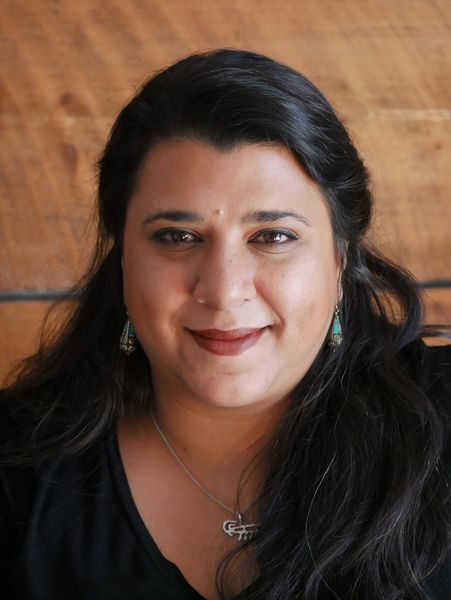
Elyssa Marcoux-Bissondath (Photo by Antoine Dumont)
When she was ten, Dido found an old book in a hole-in-the-wall second-hand bookshop: Aeneas and Dido. Growing up bilingual in Québec City, it was with a certain guilt that Dido naturally gravitated towards anything not in French, out of the ordinary, like her. That and stood out in a sea of et. It made her feel slightly impertinent, but she couldn’t deny the draw.
The book was part of an ill-advised and short-lived children’s series on famous love stories from around the world called Beyond the Tales Grimm. The back cover listed other couples: Tristan and Isolde, Romeo and Juliet, Antony and Cleopatra, Bajirao and Mastani. She only ever got Aeneas and Dido, presuming the publishers discontinued the series when they realised that “… and everyone died, miserable and alone,” no longer sold as well as “… and they lived happily ever after.”
Besides, the format can’t have been cheap. The hand-sewn pages were big, protected by a hardcover as tall as her torso and wrapped in a fraying purple cloth. A bronze oval in the centre framed a night scene: ships in a bay overlooked by a cliff topped with huge stone ramparts from which flames erupted. The same gusts of wind, stitched pearly grey, that filled the ships’ sails carried embers to the stars.
It is a story I know well. It is part of an epic I first gave Vergil over two thousand years ago. He had a rather different focus at the time, concerned with empire building and the legitimacy of Rome. Neither of us was ever satisfied with his poem — he let politics interfere too much.
As the picture book told it, the story of Aeneas and Dido was a simple one, and rather shorter than I remember.
Excerpt from A Hungry Fire. Copyright Élyssa Marcoux-Bissoondath 2026. Printed with permission of Cormorant Books.
____________________________
Élyssa Marcoux-Bissoondath is a bilingual, biracial author who has worked as a production editor for both CBC and Radio-Canada. She holds a Masters of Fine Arts in Creative Writing from the University of British Columbia and undergraduate degrees in Classical Studies and Ancient Oriental Languages from Université Laval. She resides in Québec City, QC.