Read an Excerpt from CARRYING WAR, the Affecting New Memoir by Tanya Bellehumeur-Allatt
Carrying War by Tanya Bellehumeur-Allatt banner
Some experiences never entirely leave us. The new memoir, Carrying War (Dundurn Press) traces how encounters with violence, instability, and fear can continue to shape a life long after the immediate danger has passed.
Tanya Bellehumeur-Allatt was twelve and living in Israel when she first experienced true terror and trauma. Not long afterward, her family moved to Beirut during the Lebanese Civil War, accompanying her father on a United Nations peacekeeping mission. Across these narrative essays, memories of the Middle East reach into later experiences in Europe, Quebec’s Eastern Townships, and Yellowknife, as the book considers the many ways that fear can follow us from one place and period of our lives to another.
At the same time, Carrying War explores what it means to keep living beyond that fear, and the possibility of hope even when scars from the past remain. In the excerpt featured below, readers get a glimpse at Bellehumeur-Allatt’s deeply personal rumination on memory, trauma, and the experiences we carry with us across years and borders.
An Excerpt from Carrying War by Tanya Bellehumeur-Allatt
Jeep noun
a multi-purpose motor vehicle
#
My father takes us to Sabra and Shatila — Palestinian camps in southern Beirut — one evening after supper.
He switches the radio to a French news channel and turns up the volume as we drive away from the coast.
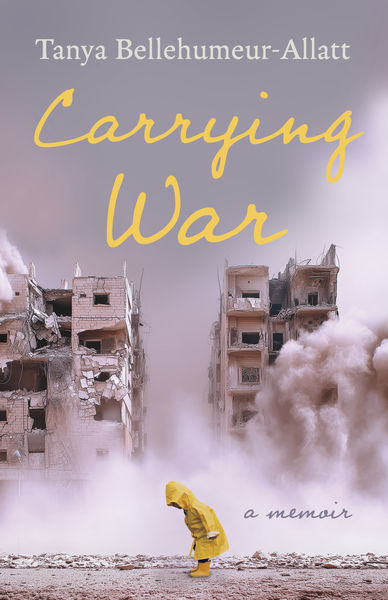
Carrying War by Tanya Bellehumeur-Allatt
We pass a UN checkpoint and enter through a gate. Cement walls topped with embedded glass shards and razor wire surround the enclosure.
Your CanLit News
Subscribe to Open Book’s newsletter to get local book events, literary content, writing tips, and more in your inbox
My father slows the Jeep to a crawl. The wind that whipped the UN flag a few minutes earlier has died. The flag hangs limply. My father flicks on the Jeep’s high beams, showing two massive piles of dirt on either side of the entrance. Farther on, I can make out cinder-block houses with red graffiti spray-painted across them in undecipherable Arabic.
“What’s with the huge piles of dirt?” Etienne asks.
Maman keeps her head down. She fiddles with her hair.
“Those are mass graves,” my father says.
The radio announcer drones on about soccer championships in clipped European French.
“Turn that off,” my mother snaps. She presses buttons on the Jeep’s console, but the radio keeps playing. Finally, she finds the volume button.
“Thirty-five-hundred people were killed here in September,” my father says. “Mostly women and children and the elderly.” He drives the Jeep forward. I try not to imagine the bodies piled up under the layers of sand and mud.
The narrow street — barely wide enough for our Jeep — is littered with garbage. The houses are dark. On the side of one I make out the English words “Sabra and Shatila Massacre, September 1982.”
“It took place over three days,” my father says. “The fighters used military flares at night to help them see.”
“Who did it?” Etienne asks.
“No one has claimed responsibility,” my father says. “But we suspect Lebanese Phalangists. With help from the Israel Defense Forces.”
“That’s enough,” Maman says. “Take us back.”
But the road is too narrow. There is no place for the Jeep to turn around.
knife noun
a simple instrument used for cutting
#
In Yellowknife, my father equipped us each with a Swiss Army knife. Maman’s was small, with only a few appendages — a pair of scissors, a couple of blades, a file. She kept it in her purse until it was confiscated by an El Al attendant in plastic gloves before we boarded our flight for Tel Aviv.
My brother’s knife is the fat one — fully loaded — with every sort of blade and gadget, including the can opener and the white toothpick.
My knife is a version in between Maman’s and Etienne’s. I carry it with me every day in a special zippered pouch in my school bag. Someday one of the Lebanese guards stationed outside the American embassy gates, next to the tank, will find it. He’ll feel it against the polyester fabric, undo the zipper with curious fingers, and lift it from its special place. But most mornings, it’s the same two guards. They recognize us. We show them our ID cards, they unzip our bags and give them a cursory pat, flip through a schoolbook or two, and wave us on.
Until recently, I’ve used my knife to cut loose threads on my jeans or make paper snowflakes. On a camping trip on Great Slave Lake, I used my knife to whittle a branch for a marshmallow stick. But on Friday afternoon, while the other girls are doing basketball drills in the gym, I lock myself in a bathroom stall and take my knife out of my bag.
I choose the largest, sharpest blade. I roll my sleeve to my elbow, turn my left wrist, and open my palm, run my thumb over the thin flesh.
Bring the blade down hard. I need to feel the sharp pain, need to see the bright drops of blood fall on the toilet seat.
It’s harder than I imagined. The skin resists. Human flesh is harder to whittle than wood.
I press the blade, hold my breath, listen to the pounding of the basketball against the gym floor, the whistle — two short blows and a longer one — followed by the angry buzzer. They must be playing a game now. How long before the coach notices I’m missing? I want him to leave the game and come looking for me, but I know he won’t.
I mop up the blood with toilet paper. It sticks to the fresh wound. I unroll my sleeve, pull my hoodie over top. It’s too hot for muggy April in Beirut, too hot for the gym.
I leave the stall, look out the bathroom window at the four American warships in the bay with their cannons pointed at the city. Pointed at the school. Pointed at me.
At least I feel something now rather than just the numbness. If I stop feeling, if I catch myself slipping back, all I have to do is press hard on the inside of my wrist.
Next time, I’ll cut deeper. It’ll be easier, now that I know what to do.
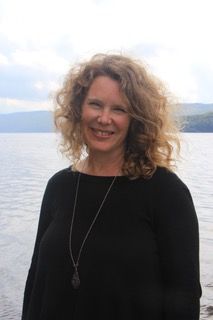
Tanya Bellehumeur-Allatt
library noun
a building given over to books
#
I’m sitting alone in the library at Beirut’s American Community School, reading. I enjoy spending my free period in the stacks, an oasis of quiet in the middle of my day.
Suddenly there’s a deafening boom, a sound louder than I’ve ever heard before. Everything shakes. The room goes black. Books fall off the shelves. The chairs next to me roll over. A window cracks and splits, sending shards flying.
My breath comes loud and ragged. Voices shout in Arabic. I don’t know what they are saying, or what to do, so I stay in my seat and wait for my eyes to adjust to the cavernous dark.
Sirens blare. Panic simmers in my chest, threatens to choke me.
I sit for a long time, listening to the chaos, until my French teacher finds me and leads me to his classroom with a flashlight. We conjugate French verbs by candlelight. It’s not until last-period English class that I learn the news. A deadly bomb has exploded at the U.S. embassy, next door.
At 3:30 p.m., when the bell rings and it’s time to go home, red DANGER tape encircles the school.
#
missing adjective
not able to be found; not present; absent without explanation from one’s home or usual or expected place
#
My mother answers the door on my father’s birthday, heaving its thick, bulletproof bulk open to find a grim messenger. Daddy is lost — caught in the crossfire — and is missing in action.
Daddy is dead. Dead. He won’t be coming home again. Ever.
A few hours later, we hear the lock turn. The front door opens.
“A hot bath and bed,” my father says, as if speaking to himself.
We stare at him. My mouth fills with hot, dry air and makes my body light.
“T’ étais où?” Anger tinges Maman’s voice.
Daddy takes off his glasses and wipes his face with his hands. He shuts the door behind him. “I got caught behind enemy lines. My partner wanted to go farther, to see what was behind the barricade. I never should have agreed …”
#
neutral adjective
not engaged on either side; not siding with or assisting either of two or more contending parties; not involved in hostilities
#
“What kind of weapons do you have out there?” Etienne asks. “Pistols? Revolvers?”
“It’s against the rules,” Daddy says. “Blue Berets don’t carry arms.”
Excerpt from Carrying War. Copyright Tanya Bellehumeur-Allatt 2026. Printed with permission of Dundurn Press.
____________________________
Tanya Bellehumeur-Allatt is the author of the critically acclaimed Peacekeeper’s Daughter: A Middle East Memoir as well as two poetry collections, The Hospitality of Trees and Chaos Theories of Goodness. She lives in North Hatley, Quebec.