Read an Excerpt from HIDE AND SIKH, the New Memoir from Sunny Dhillon
After leaving his job at The Globe and Mail in 2018, Sunny Dhillon published a blog post explaining his decision. It struck a nerve, circulating widely and inspiring conversation about race, belonging, and the limits of diversity in Canadian journalism. What followed became the starting point for our featured memoir.
Written as a series of letters to his daughter, Hide and Sikh: Letters from a Life in Brown Skin (Wolsak & Wynn) traces how Dhillon learned to live with and eventually push back against the pressure to make himself smaller. He recalls growing up unsure how to respond when his differences were pointed out, and how hiding his skin colour, language, and even his name once felt like survival. Told with humour and plainspoken honesty, these reflections are offered as a kind of legacy: a record of hard-won discovery, and a hope that his daughter can grow up knowing who she is, without apology.
We're delighted to feature an excerpt from this fascinating memoir right here!
An Excerpt from Hide and Sikh: Letters from a Life in Brown Skin by Sunny Dhillon
Prologue
Jaya,
It happened earlier today. You and I were at a playground near our new home, here in Ottawa. Your mother was recently offered a promotion and we opted to make the move. It was not an easy decision. Almost everyone we know is now thousands of kilometres away, including our immediate family. You have spent your entire life in something resembling isolation due to the Covid pandemic and moving you away from your loved ones – especially your grandparents, just after they were vaccinated – felt cruel. But there were plenty of reasons to go for it, as well. For one, it was an exciting opportunity for your mother, something she had worked tirelessly to obtain. For another, I seemed to have exhausted all career possibilities in Vancouver and thought the change, any change, might do some good. And even with our one-salary household we were able to purchase a home close to the city centre, an outcome that was not in the cards for us on the West Coast. We are grateful to have found a place within walking distance of the Rideau River, near green space and trees. Even this far away from where we grew up, where you were born, it does make us feel a little closer to home.
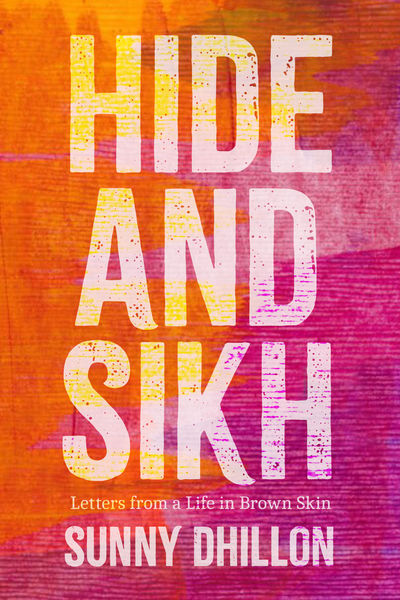
Hide and Sikh: Letters from a Life in Brown Skin by Sunny Dhillon
Our time here in the nation’s capital has been up and down thus far. As much as we worried for you during the flight, both due to the pandemic as well as the fact that babies can struggle with their first plane ride, you were unfazed. You played with toys, watched cartoons, stuffed your belly and even took a nap. You did start tugging at your right ear near the very end of the trip, an indicator perhaps that if the flight had been any longer the change in air pressure would have gotten to you. Thankfully, it did not come to that.
Though we took this as a sign that we were in the clear, that the hardest part was over, this was very much incorrect. You did not welcome your new bedroom and clearly missed the security of the old one. To make matters worse, it was not possible to sleep in your regular crib – it was on a moving truck somewhere to the west – and you had to make do with a portable version that you strongly dislike. You also had some new teeth coming in and hit what we are pretty sure was your eighteen-month sleep regression. It was a perfect storm, resulting in you being up at least a dozen times a night, often crying inconsolably. None of us slept well during this period, including – though they have been too kind to admit it directly – our new neighbours.
Your mother works long hours and so it has, at times, been up to you and me to explore the city, its galleries, its museums, together. It has been an absolute blast. I could show you Group of Seven paintings all day, even as your eyes tell me that you either prefer the European works or want a snack.
Our new suite is not as large as the previous one and I have been trying to get you to the park as much as possible so you can run to your heart’s content. You are more than happy to oblige. Though I am generally opposed to terrorizing animals, I have allowed you to pursue your new favourite hobby: chasing seagulls. I figure this makes us even, given the sheer number of times that they have pooped on me over the years, a record only you have since surpassed.
Your CanLit News
Subscribe to Open Book’s newsletter to get local book events, literary content, writing tips, and more in your inbox

Sunny Dhillon (Photo by Sunny Dhillon)
The playground that we most regularly frequent is a five-to-ten-minute walk from the seagull grounds, depending on the pace at which we move. Your preferred component changes by the day. Sometimes, you only want to go down the slide. At other points, you desire the swings. And there are occasions when you want nothing more than to just climb up and down the rubber steps.
Your playground experience, if not your experience of the world, can be much different when you are with your mother. If she, as an attractive White woman, takes you into a store that sells baby products, you are swarmed by employees. If I, as a less attractive Brown man, enter that same store, salespeople tend to walk in the opposite direction. This manifests in a similar way at the playground. Your mother returns home with stories of the children with whom you engaged, of the new moms who introduced themselves. When it is you and me, though, the reception can be chilly. We once met a neighbour who had a daughter the same age as you. I thought this was a welcome opportunity for you to have a friend within the building. However, the next time we saw the mom she hid with her stroller behind a parked car until we were at last out of sight. It was extremely dispiriting. This, of course, is not to suggest that women do not have legitimate reasons to be suspicious of men who might seek to weaponize the kindness that one shows their children. I get it because, well, I have also been on the wrong end of that trick.
When the father and his young son approached us on the playground, the dad asking if it was all right for them to be nearby, I smiled and said sure. I did not want them to feel as unwelcome in that space as I sometimes do. I did not want to put a damper on their day. It was a decision I would regret.
___________________________________________
Sunny Dhillon is a former news reporter whose viral essay “Journalism While Brown and When to Walk Away” highlighted the significant challenges that journalists of colour can face. Sunny worked as a print reporter for ten years. He has also appeared on television and radio and has spoken at conferences. He is passionate about racial justice and continues to write on that theme. He holds a master’s degree in journalism from the University of British Columbia. He and his young family now live in Ontario, where Sunny attends law school. This is his first book.