Read an Excerpt from MOBILIZING DATA FOR JUSTICE: A GUIDE TO ACTIVISM IN THE DIGITAL AGE
Data has become a key site of power, and a growing number of activists are finding ways to use it in the fight for accountability and change. The timely new nonfiction title, Mobilizing Data for Justice (Between the Lines), looks at how information is gathered, controlled, and challenged in movements working across labour, housing, policing, and environmental justice.
The book highlights real-world efforts to make hidden systems visible, from exposing tax havens to tracking evictions and documenting wage theft. It shows how community groups, unions, and grassroots organizations are developing technical skills to collect and interpret data on their own terms, often outside traditional institutions. These practices reshape how evidence is built and used in social struggles.
Written by Chris Hurl, Elena Rowan, Marius Senneville, and Kevin Walby, the book draws on interviews with more than fifty data activists around the world. It offers both a clear overview of emerging strategies and a practical sense of what it takes to turn information into action in the digital age.
We've got an excerpt from this engaging and essential new work to share with our readers, so read on!
An Excerpt from Mobilizing Data for Justice: A Guide to Activism in the Digital Age, Edited by Chris Hurl, Elena Rowan, Marius Senneville, and Kevin Walby.
Building Capacity: Research with Rather than About Social Movements
A growing body of sociological literature about social movements sets out to explain the rise of digital activism, debating how much has changed as social movement organizing has moved online, with some viewing this as a paradigm shift—often framed as a new epoch of “hacktivism”—while others draw continuities with past struggles. There are also academic discussions about the efficacy of such forms of organizing. While some argue that digital activism has contributed to more decentralized, dispersed, and flexible forms of organizing, others argue that it has led to “slacktivism,” as people have come to express their political convictions with their clicks rather than their feet. And there are concerns about the social motivations of those engaged in these kinds of movements, with studies seeking to understand the sociological backgrounds of participants in everything from the far-right manosphere to Black Lives Matter and the #MeToo movement.
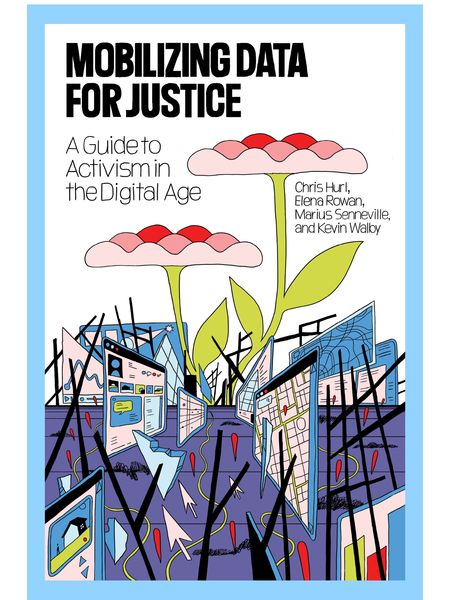
Mobilizing Data for Justice by Chris Hurl, Elena Rowan, Marius Senneville and Kevin Walby
Our book is not concerned with these questions, which have been discussed elsewhere at length. We’re not concerned with conducting a sociological investigation examining the interests, motivations, or social background of activists engaged in data activism. Such research is often of little use for social activists. (32) Rather than developing knowledge about social movements—treating social movements as an object of academic investigation—we are interested in developing knowledge with social movements, generating theories in dialogue with activists themselves with the aim of facilitating capacity building. This, in turn, changes the nature of the questions that we ask. Rather than trying to explain why social movements use data in the way that they do, we explore how different strategies and techniques can be applied by people engaging with data in the interests of social justice. In this way, we are interested in developing what Douglas Bevington and Chris Dixon describe as “movement-relevant” theory: “theory that is useful and accountable to movements” and that “can inform and assist movements” in their struggles.
This does not mean uncritical adulation of social activists and their work. Rather than falling back on hero narratives, we think that movements are better served by contributing to the development of objective knowledge about the relations of ruling that they must negotiate. In their struggles, activists confront powerful actors that broker access to data through opaque infrastructures and regulatory practices, taking advantage of information asymmetries in ways that facilitate control. In confronting these infrastructures on the ground, we see activists as skilful actors who, through experience, cultivate knowledge of how they operate. This involves a process of trial and error, testing out different methods through which to generate knowledge. As community education activist Budd Hall notes, “knowledge is produced and renewed by continuous testing, by acting upon one’s theories, by reflecting upon one’s actions, and by beginning the cycle again. It is the combination of social transformation and education that has created the kind of knowledge which forges the personal and communal commitment for sustained engagement.” (34) Over time, this dynamic can build capacity for social movements, as data gathered is used to mobilize people, which, in turn, brings more people into the ranks to gather and analyze data.
With a focus on building movement capacities, this book explores two aspects of data activism. First, we explore how activists engaging in data activism make sense of the institutional landscape in which they operate. What strategies do they develop to understand the practices of governments, corporations, and other powerful actors? What techniques and technologies do they apply? Taking as our starting point the practical challenges that activists face in accessing data, we are interested in their strategies for making sense of the institutional settings and digital environments through which access to information is brokered.
We show here how social activists have a lot to teach us about the way in which social institutions and their attendant data infrastructures operate. Through the course of their struggles, activists have developed various methods that bring to light the “access regimes” that they confront, so as to better inform political action. This includes making sense of the laws and procedures, bureaucratic mechanisms, and regulatory agencies through which access to data is brokered in a given jurisdiction. (35) It also includes making sense of the digital environments that activists must learn and negotiate to gather information, for instance, in the process of sifting through digital records and archives, undertaking FOI requests, and making sense of large and complex files, such as contracts and budgets. Exploring how activists deploy strategies to transform challenging, opaque organizational circumstances into targets for social action, we thus set out to chart how relations of ruling are organized in the digital era, as well as tracing how these relations are changing with the development of new technologies.
Your CanLit News
Subscribe to Open Book’s newsletter to get local book events, literary content, writing tips, and more in your inbox

Chris Hurl, Elena Rowan, Marius Senneville, and Kevin Walby
Second, making sense of access regimes requires skills that are learned. Drawing from the recent literature on social movement learning, we are interested in how the strategies that activists take up in making sense of and confronting these institutions are fostered and shared, contributing to capacity building in social movements. This involves looking at what Alan Sears calls “infrastructures of dissent,” the “range of formal and informal organizations through which people develop their capacities to analyze and map the system, communicate using official and alternative media, and take strategic action in solidarity with others.” (36) While data activism is often presented as the product of individual savants like Edward Snowden or Julian Assange, we contend that it depends on fostering relations of support and care among social activists. As Aziz Choudry notes, “learning is a social practice based on participation in a community of practice rather than the acquisition of knowledge by individuals.” It is “a process of becoming part of a community and being able to fully function within it,” which involves “build[ing] time and space for collective reflection.” While there is a growing literature on social movement learning, (39) researchers have seldom looked at data activism from this perspective. Often studies focus on the local context rather than the digital lifeworld in which activists operate. (40) Our contribution is in examining how movement groups can generate critical digital literacies, developing competencies in navigating digital regimes through which access to information is brokered. Moreover, with this book—as well as through our website, podcasts, and guidebooks—we also provide spaces where this learning can happen, creating opportunities for deliberation on the best ways to engage with data in pursuit of social justice.
Appendix:
32. Jake Godin, “Satellite Imagery Shows Vast Destruction in Rafah,” Bellingcat, 27 August 2024, bellingcat.com.
34. Interview with Accountability Archive.
35. Interview with Bellingcat.
36. Tactical Tech, “Visualising Information for Advocacy,” 2nd ed., 2014, visualisingadvocacy.org.
39. Silas Xuereb and Craig Jones, “Estimating “Estimating No-Fault Evictions in Canada: Understanding BC’s Disproportionate Eviction Rate in the 2021 Canadian Housing Survey,” 2023, ubc.ca.
40. Xuereb and Jones, “Estimating No-Fault Evictions.”
Excerpt from the introduction of Mobilizing Data for Justice: A Guide to Activism in the Digital Age, edited by Chris Hurl, Elena Rowan, Marius Senneville, and Kevin Walby. Published by Between the Lines on March 17, 2026.
____________________________________
Chris Hurl is an associate professor in the Department of Sociology and Anthropology at Concordia University. His research examines the politics of knowledge production in public sector restructuring. He is the coauthor of The Consulting Trap and coeditor of Professional Service Firms and Politics in a Global Era and Corporatizing Canada.
Elena Rowan is a graduate student and researcher in the Department of Sociology and Anthropology and the Department of Psychology at Concordia University. Her research explores the intersections of culture and community in sociology, anthropology, and clinical psychology. Her graduate research looked at questions of community, copyright, and advocacy within libraries, published in Platform Power and Libraries. She produces the Data Justice Hub podcast.
Marius Senneville is a Montreal-based researcher trained in STS and political economy. His academic works have touched upon the AI innovation ecosystems in Montreal and Toronto and the changing forms of partnerships being developed between university and industry laboratories. He also investigated the way AI governance emerged as a strategic sector of management consulting and the different actors vying for market credibility. He currently works as an applied researcher at CÉRSÉ, where he is developing the research programs on the digital sectors and renewable energies.
Kevin Walby is a professor of Criminal Justice at the University of Winnipeg. He is coauthor of Police Funding, Dark Money, and the Greedy Institution. He is coeditor of Disarm, Defund, Dismantle and Changing of the Guards. He is the director of the Centre for Access to Information and Justice (CAIJ) and coeditor of the Journal of Prisoners on Prisons.