Read an Excerpt from TAKE THIS FOR THE PAIN, the Fascinating New Essay Collection by Alex Boyd
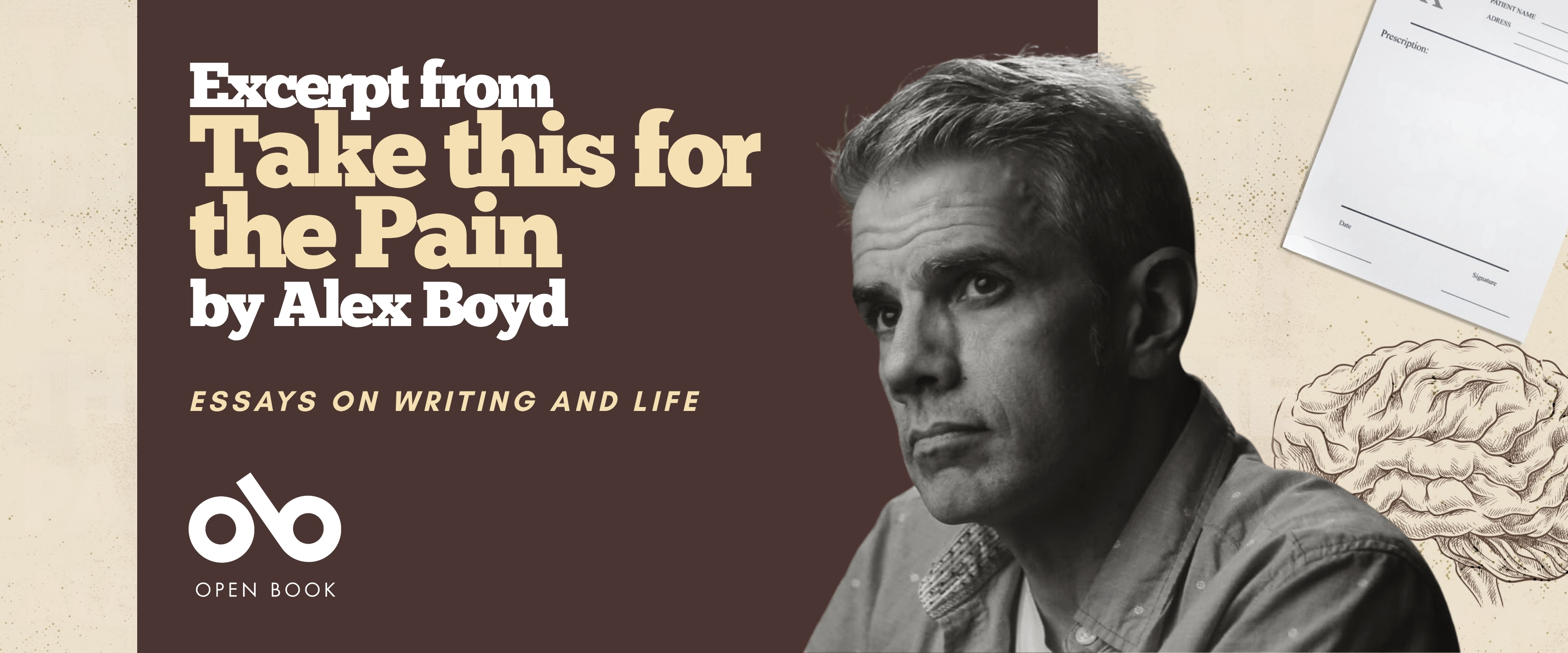
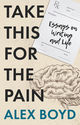
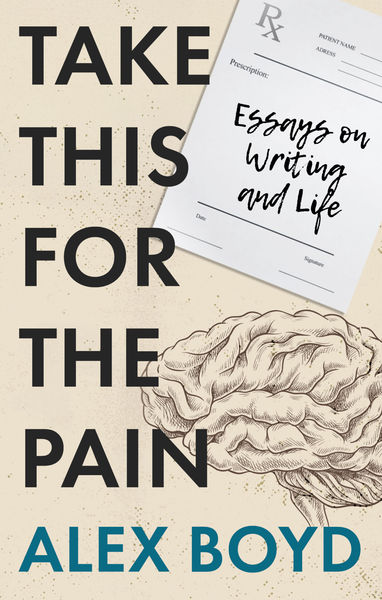
Art has a way of turning up in unexpected places, and Take this for the Pain (Palimpsest Press) follows those moments wherever they lead. Drawing on twenty-five years of essays, reviews, and criticism, the collection ranges across literature, music, faith, work, politics, and the everyday questions that keep resurfacing over the course of a life.
Rather than offering definitive answers, Alex Boyd approaches each subject with curiosity, humour, and a willingness to rethink his own assumptions. Whether he's writing about the value of poetry, the place of graffiti, or books that deserve a wider readership, Boyd is interested in how art shapes the way we understand ourselves and the world around us. The essays are personal without being inward-looking, inviting readers into an ongoing conversation rather than a final verdict.
Today, we're featuring an excerpt from Take This for the Pain, offering a taste of Boyd's thoughtful, wide-ranging prose and his enduring belief that books, ideas, and art still have the power to challenge us, comfort us, and ultimately change us.
An Excerpt from Take this for the Pain by Alex Boyd:
FLYING BLIND:
THOUGHTS ON FAITH
In a film called The Passenger, a woman stands up in the back seat of a car and faces backwards so that all she can see is the road whisking away behind the car, covered by a thick canopy of trees and leaves. In effect, she turns backwards and faces the past, rushing away, while at the same time she sails into the future blind to it, unable to tell what's about to happen. It's a small but fascinating moment, because we're all in this situation. We're all forced to acknowledge things we didn't anticipate, however prepared we were. It's simply the way humans live. I wonder what we can conclude about this constant awareness, buzzing in the back of our minds, and what we can do to help muffle that noise.
Take this for the Pain by Alex Boyd
You and I sit holding certain cards, certain known truths. We've put our hands out into the world and felt around for certain trustworthy conclusions. There are always parts of the equation we haven't seen, and yet in conversation, people often want to appear infallible. My father is one of the few people I know who will simply state, "I don't know anything about that," which is the sort of thing you can't say without making people uncomfortable, and that in and of itself says something about our culture, but he doesn't care. To compensate for our ongoing lack of complete knowledge we like to pretend we know more than we do, for the sake of confidence, comfort and certainty. And we risk closing the lines of thought with hastily drawn conclusions.
Faith fills the gaps, helps us complete a picture when we don't have all the pieces. It helps us live without distrust and fear and hostility. Science and technology can do remarkable things, but if we were to be completely honest with ourselves, we'd admit that science and faith are not incompatible. Studies have suggested that people concerned about today's problems, environmental and otherwise, have a faith in technology's ability to solve them. Apparently, it's fine for us to slice away at the resources of the earth, because we'll find some technological way around every problem. Still, we can't guarantee these things, so we're taking science on faith.
In humility we find recognition we play a small part in the world, a willingness to see there are unanswered questions, instead of a pointless attempt to gloss over it with overconfidence and stabs at power. Canadian poet Irving Layton has a great moment in an interview where he addresses this:
"We have to fight this desire for the power, the desire to humiliate others, for that comes from our own terror of death and is an attempt to give our lives some kind of significance beyond the insignificance of the moment. You see, Freud was quite wrong when he thought that the guilty thing that people were repressing was sex. What people repress is the fear of death and the knowledge of their insignificance. It is this that breeds sadism, cruelty, and the desire to humiliate others... Man is the only animal that is aware of death... and he simply cannot come to terms with it. So our education should not be an education for sex, but an education for the acceptance of death and our own unimportance. In the billions and billions of years rolling ahead, what are we? My God, we're not even a speck, not even a mote. It's very hard for human beings to accept that, therefore the desire to humiliate someone else, to beat, to brutalize."
When our desire for faith hardens over time into inflexible rules we run the risk of falling into patterns, becoming unthinking followers. This is my main difficulty with religion when practiced without humility and flexibility: good ideas are generated when our questions are as meaningful as our answers, and our questions come out of what we admit we don't know. Instead of heaping scorn on my father for saying "I don't know," I began to respect him for it. To admit you don't know something is a beginning, and an honest one, providing you aren't dismissive. Bertrand Russell suggested that any opinion can be held the way scientists maintain a conclusion, meaning tentatively, in case some better piece of evidence should come along. If surrounded by too many inflexible rules, faith is not allowed to evolve. A degree of uncertainty is useful, and if we need faith to survive (and enjoy reverence, perspective, greater mental health, peace), then the question becomes how best to practice a balance of uncertainty and faith.
Your CanLit News
Subscribe to Open Book’s newsletter to get local book events, literary content, writing tips, and more in your inbox
Alex Boyd
In Ireland I visited an empty cathedral and found a moment to sit and breathe in my aloneness. I was aware we used to build cathedrals the way we now build money temples: banks and malls. I lit a candle for my Mom, who had passed a few years before, and igniting a candle I pictured a beam of light, a signal much higher than the small flame. I watched a statue, my naked eye unable to see any change, the slow dissolve into powder. It was simply a frozen moment, and I put my hand on stone folds, the gentleness of fabric caught in rock. One corner of the sun came through the stained glass, nearly blinding me and beating like a coloured wing.
There's nothing mysterious about my experience, and someone else could pass through the same environment and scoff. Faith is intangible because only my desire, my belief in it allows me to feel that I have it. Other experiences, though few and far between, are less explainable. In the months after my mother died, I still lived with my father in a very quiet house, sometimes listening to the sound of him heating up soup, and his spoon scraping the bowl.
While on the phone in the basement, I heard a thwack.
I found that a framed photograph of my brother and his wife on their wedding day, a photo that had stood untouched for years, had fallen onto the ground, as though someone replaced it incorrectly. My sister had her son after our mother passed away and years later reported to me that he spontaneously asked, "Who's that smiling lady?" a few times when, clearly, nobody was with them. He'd eventually point to a photograph of our mother on the wall and explain that was the woman he saw.
Building and maintaining personal faith is an ongoing challenge. In A Grief Observed, C.S. Lewis puts it like this:
"Five senses; an incurably abstract intellect; a haphazardly selective memory; a set of pre-conceptions and assumptions..."
_____________________________
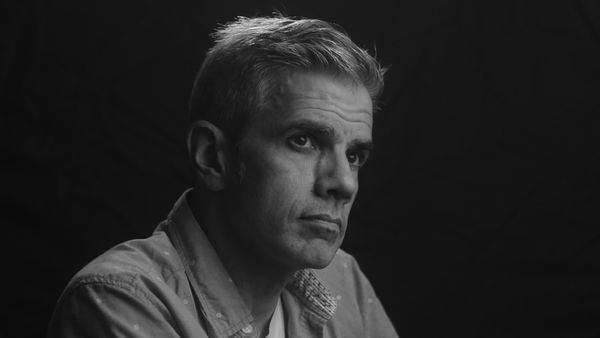
Alex Boyd has written for publications such as The Globe and Mail and Taddle Creek magazine. He helped establish Best Canadian Essays, co-editing the first two collections of work selected from Canadian magazines. His poetry collections are Making Bones Walk (2007) winner of the Gerald Lampert Memorial Award, and more recently The Least Important Man (2012). In 2018 his first novel was published: Army of the Brave and Accidental, a retelling of The Odyssey reviewed as “timely, original and profound.”