THOSE ARE PEARLS Author André Narbonne Takes on Our Storytellers Interview
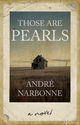
One decision can echo through generations, and we've seen this play out time and time again in some of Canada's best fiction. In the new novel, Those Are Pearls, a young man's pursuit of love becomes the starting point for an expansive family saga that stretches across continents, and weaves through some of the defining events of the twentieth century.
André Narbonne starts the story with Harry Short, who first goes to war hoping to win the affection of Margaret Roll, then returns to battle years later for very different reasons. From South Africa to the Canadian Prairies and the battlefields of Europe, the novel follows the Short family as they build new lives, endure upheaval, and find themselves caught up in everything from homesteading and labour unrest to war, political conflict, and natural disaster. History is ever-present, but it is the family's evolving relationships that remain at the heart of the story.
Today, we've got a Storytellers Interview with the author! Where he talks about some of his writing influences, and where Those Are Pearls fits into, or bucks against, specific CanLit lineages. Read on, folks!
Open Book:
Which authors have inspired you and/or influenced your work?
André Narbonne:
All of them. As a reader, I have been a barracuda. If it’s shiny, I go for it. Looking over the books I admire, there doesn’t seem to be much of a pattern. I discovered The Tin Drum and The Painted Bird while I was in high school, and maybe because I was in high school, they had a tremendous impact on me. Around that same time, I couldn’t put down Shōgun. I read it in three nights and failed three high school math exams on consecutive days as a result. True story. I don’t know anyone who would put James Clavell on the same list as Günter Grass and Jerzy Kosiński.
One of the greatest influences on my writing has been Canadian literary journals. In Grade 13, I wandered downtown to St. Paul Street in St. Catharines and bought a copy of The Fiddlehead. I was seventeen and floored by the possibilities. I didn’t know fiction and poetry could do those things. I’ve been a fan of Canadian literary journals ever since. So many writers whose names I never learned have shaped my writing. I wrote for them, to enter their conversation in those same journals.
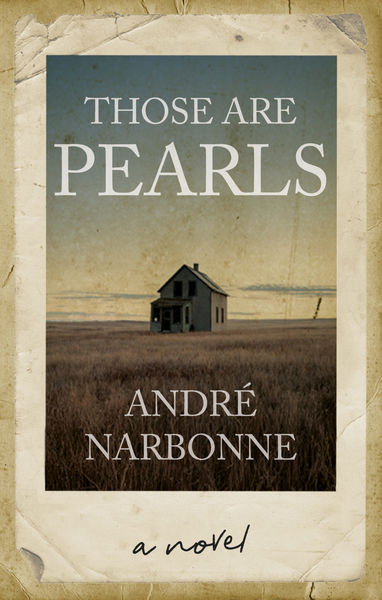
Those Are Pearls by André Narbonne
OB:
How have you bent or broken the rules of established literary traditions to develop your own style and voice?
AN:
I consider myself a neo-realist. I use theory, but I’m not writing theory. Rather, I’m trying to create an expression that feels palpably real to twenty-first-century sensibilities, and I’m using everything and the kitchen sink to do it.
The nineteenth-century realists were mostly religious. Mine is the realism of an atheist, and my voice is the voice of an ironist—if an ironist were interested in building rather than simply tearing down. It’s tonal, the sound I hear in my head when my narrator is describing the world.
Your CanLit News
Subscribe to Open Book’s newsletter to get local book events, literary content, writing tips, and more in your inbox
When I wrote my first novel, I picked away at it, writing different sections like stepping stones for crossing a river. After I wrote the sentence, “He shuffles into the lock house, a squat, brick building with the architectural refinement of a Hell’s Angels clubhouse,” I had found my voice and could finally write the novel from beginning to end.
Irony is a sense of doubleness. Things have two meanings. That may suggest postmodernism if you read it as equivocation or rejection, but my main interest is character and the multiplicity of meanings that allow ordinary events to stump us.
OB:
What impact would you like your fiction to leave on readers?
AN:
I’ve described myself as a neo-realist. I’m also a literary sentimentalist. That is, I want readers to feel.
Sentimental literature tends to have a hidden—or not so hidden—politic. It tries to expand the reader’s sympathies to include people, lifestyles, and attitudes they might not normally accept. I distinguish this from sentimental genre fiction, which tends to confirm our beliefs.
To laugh or cry with a character is to empathize with them, and if we could empathize with more people outside our personal bubbles, I believe the world would be a safer place. I know a lot of writers say they write only for themselves. I write to an audience.

André Narbonne
OB:
Where do you see your fiction fitting within Canadian storytelling traditions?
AN:
To begin, I’m a fan. People have said to me, “I don’t read Canadian,” as though the omission were evidence of refined taste. I don’t get it.
From a young age, Canadian authors spoke to me, and their new books excited me. I read Robertson Davies—What’s Bred in the Bone is still a favourite—Alice Munro, and Mordecai Richler as their books came out. Their plots and locations became part of my own story. The funniest book I’ve ever read, Donald Jack’s Three Cheers for Me, begins in a small town in the Ottawa Valley, a place as familiar to me as a tarred road.
The tradition I see my own writing fitting into comes from authors like Davies, Munro, Richler, and Jack. They wrote compelling stories about Canada. They were invested in character, and the country itself became a character. Their stories couldn’t happen elsewhere because geography shaped the people within them. Davies’ Deptford Trilogy may be set in a fictional town, but that town is rooted in the real Ontario community of Thamesville.
What I hope my writing shares with those authors is that it is unapologetically written for the world from a Canadian perspective. Halifax, Winnipeg, and Windsor can be every bit as compelling as older, more frequently fictionalized cities.
I also recognize that there are great Canadian novels that never set foot in Canada. Michael Ondaatje’s The English Patient unfolds in England, Italy, and North Africa. Rawi Hage’s De Niro’s Game mentions Canada only ironically. That doesn’t diminish their achievements any more than it detracts from Alistair MacLeod’s No Great Mischief that it begins in Leamington, Ontario, just an hour’s drive from Davies’ fictional Deptford.
OB:
What new voices excite you at the moment?
AN:
My latest discovery is Ainslie Hogarth, and I admit I’m coming to her work a little late. I devoured Motherthing and intend to read the rest of her books.
I’m also eagerly awaiting new work from G.A. Grisenthwaite, whose Home Waltz was a Governor General’s Literary Award finalist, and Renée Bondy, whose [non]disclosure is superb.
_______________________________
André Narbonne is a scholar, writer, and the publisher of Conspiracy Press, based in Windsor, Ontario. His short fiction has been anthologized in Best Canadian Stories, won the FreeFall Literary Contest, the David Adams Richards Prize, and the Atlantic Writing Contest. A first collection, Twelve Miles to Midnight, was shortlisted for the 2017 Danuta Gleed Literary Award. His first novel, Lucien & Olivia, was longlisted for the 2022 Scotiabank Giller Prize.