The 2026 Griffin Poetry Prize Shortlist Has Been Announced
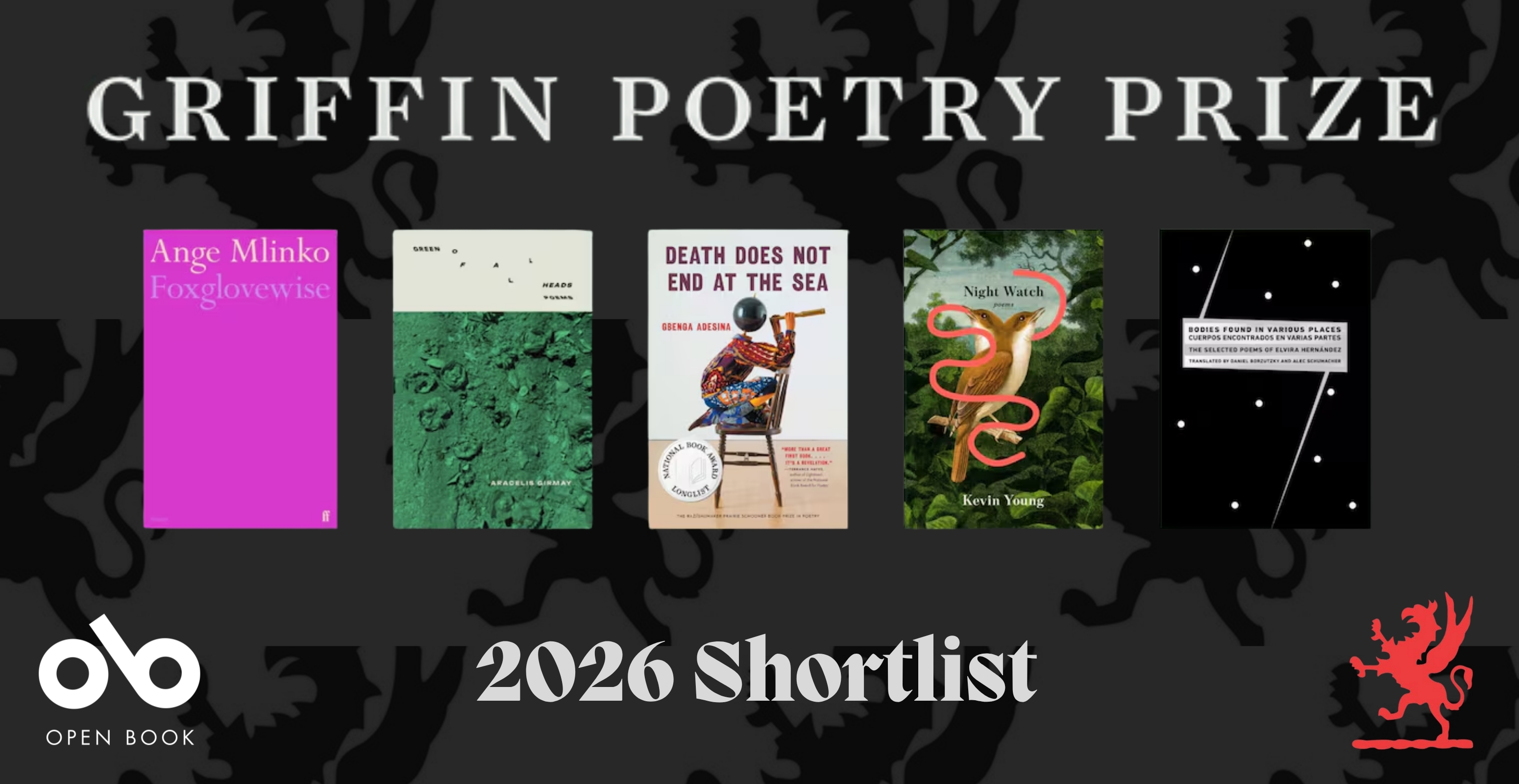
The international Griffin Poetry Prize has revealed its 2026 shortlist, narrowing a vast global field down to five collections.
After reading 461 books submitted by publishers in 42 countries, judges Andrea Cote, Luke Hathaway, and Major Jackson have selected a shortlist that moves across continents, forms, and poetic traditions—including work in translation that continues to define the prize’s international scope.
The winner will be announced on June 3, 2026, at the Griffin Poetry Prize Readings at Koerner Hall, where each finalist will take the stage. The winning poet will receive $130,000, with the remaining finalists awarded $10,000 each.
The 2026 Shortlist
-
Gbenga Adesina – Death Does Not End at the Sea (University of Nebraska Press)
A debut collection shaped as a kind of choral elegy, Adesina’s poems trace migration, memory, and the porous boundary between life and death with lyrical clarity and emotional force. -
Daniel Borzutzky & Alec Schumacher translating Elvira Hernández – Bodies Found in Various Places (Cardboard House Press)
A powerful work of translation that carries Hernández’s fractured, politically charged poetics into English, preserving the urgency and instability at the heart of her language. -
Aracelis Girmay – Green of All Heads (BOA Editions)
A luminous meditation on grief, kinship, and diasporic connection, where mourning becomes a way of seeing and a means of sustaining community across time and space. -
Ange Mlinko – Foxglovewise (Faber & Faber)
Linguistically rich and playfully layered, Mlinko’s poems move across languages and histories, building intricate soundscapes that reward close—and repeated—reading. -
Kevin Young – Night Watch (Alfred A. Knopf)
A formally ambitious and musically driven collection that blends blues rhythms with literary tradition, exploring loss, race, and memory through hypnotic, shifting sequences.
As in recent years, the Griffin shortlist reflects a deeply international group of authors. From debut voices to widely celebrated poets, and from original English-language collections to translation, the list underscores poetry’s ability to cross borders while remaining rooted in specific histories and lived experience. Of course, the consolidation of prize categories in the past, which eliminated the Canadian wing of the prize, has led to scant inclusion of Canadian poets. This year, there were no Canadians on the list whatsoever, which is the long-feared result from a number of poets and writers in the CanLit community.
Your CanLit News
Subscribe to Open Book’s newsletter to get local book events, literary content, writing tips, and more in your inbox
The June readings event will also feature appearances by the yet-to-be-announced Lifetime Recognition Award recipient and Canadian First Book Prize winner, along with a recitation from a finalist in Poetry in Voice, bringing emerging voices into the same space as some of the most accomplished poets working today.
With the shortlist now set, attention turns to Koerner Hall in early June, where the five poets will read from their work before the 2026 winner is revealed. The event remains one of the most anticipated nights in the literary calendar—part celebration, part performance, and always a reminder of poetry’s enduring power.