A Young Girl Faces Her Fears to Reconnect with Sound in WHEN BRYN'S EAR WENT QUIET
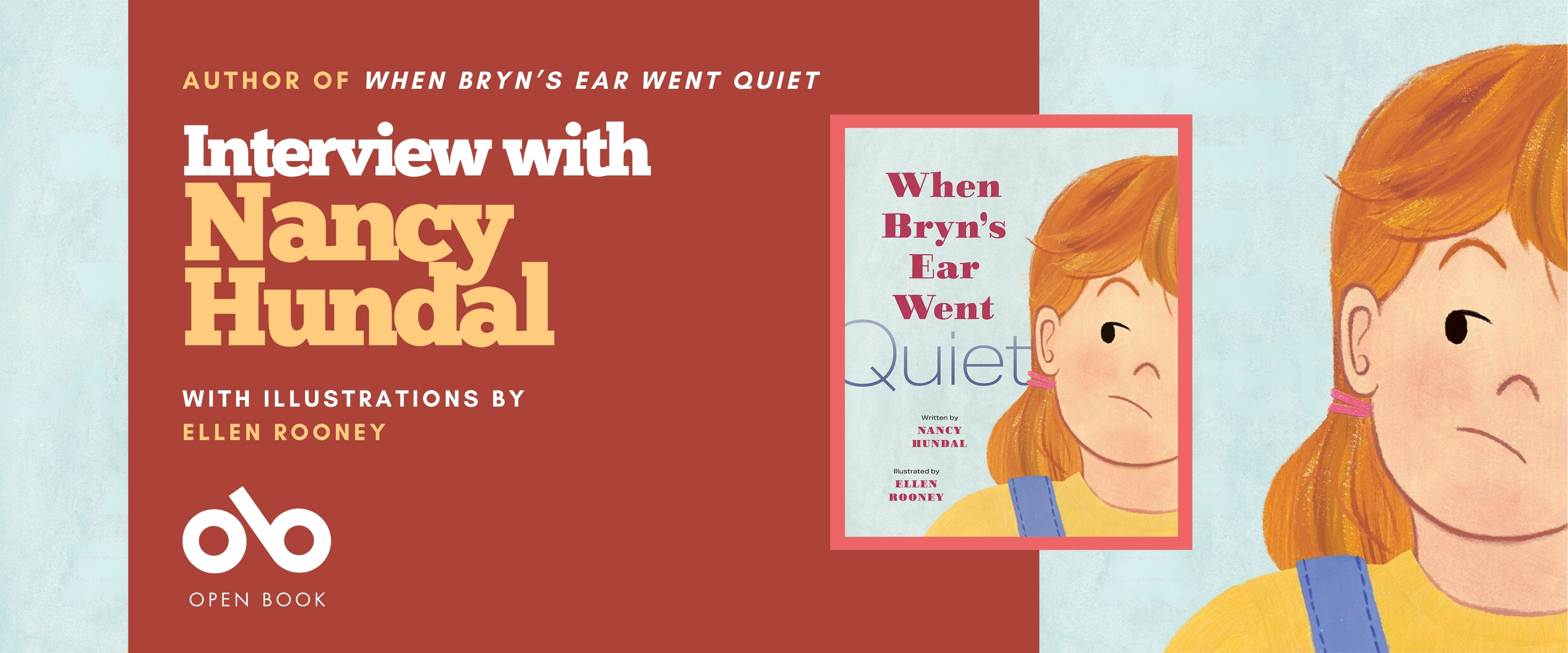
Open Book will be publishing a few special previews of upcoming titles this season, and today we're featuring When Bryn's Ear Went Quiet (Owlkids Books), an evocative new picture book from celebrated author Nancy Hundal, and brought to life on the page with captivating illustrations by Ellen Rooney.
This gentle, reassuring story follows a young girl as she prepares for cochlear implant surgery. Once able to hear clearly in both ears, Bryn has slowly lost hearing on one side, learning to adapt with the help of a hearing aid while missing the sounds she loves most.
When she is offered the chance to have surgery, Bryn faces her fears with curiosity and courage, supported by her family and the care team around her. Told from a child’s point of view, the story captures the mix of worry, hope, and excitement that comes with a hospital experience, and celebrates resilience, trust, and the joy of reconnecting with the world of sound.
You can find this heartfelt and lively picture book on shelves this January 27th, and, in the meantime, check out our interview with the author!
Open Book:
Tell us about your new book and how it came to be.
Nancy Hundal:
My new book is called When Bryn’s Ear Went Quiet. It’s the story of a girl whose hearing deteriorates in one ear. She is offered a cochlear implant operation, which is a surgery where a receiver and electrodes are implanted under the skin behind the ear. Usually, the patient’s hearing outcomes improve dramatically.
I wrote this book because I experienced severe hearing loss as an adult and was offered the chance to have the same surgery, first in one ear and then years later, the other. For me, having cochlear implants has been a miracle. I’m able to converse and interact in ways that were so limited to me before. I am so grateful.
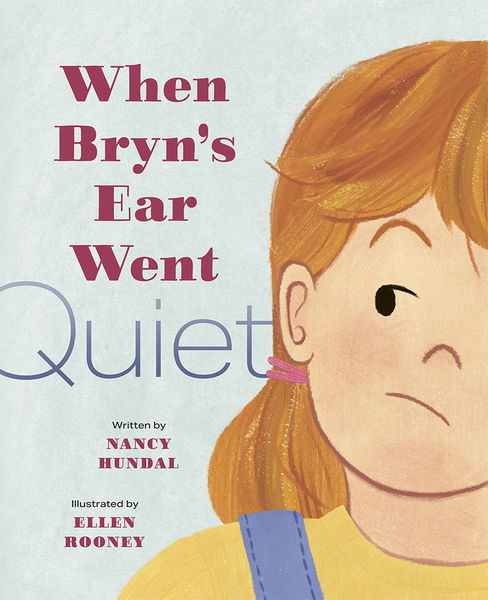
When Bryn's Ear Went Quiet by Nancy Hundal (Illustrated by Ellen Rooney)
OB:
Is there a message you hope kids might take away from reading your book?
NH:
I like to go easy on messages in my books, but there is an underlying idea in this story of demystifying an experience that could be very daunting for a young patient (or quite frankly, an older one!). It requires a bit of bravery to opt for surgery at any age, with outcomes not one hundred percent guaranteed and the knowledge of a hospital stay, anaesthetic, a bandaged, sore head, and a few other not-so-delightful realities.
Your CanLit News
Subscribe to Open Book’s newsletter to get local book events, literary content, writing tips, and more in your inbox
As an adult, it’s easier to balance those elements with the hope of a good outcome, but this could be more difficult for a child. I’m hoping that through reading the book and having a peek into the hospital environment, the experience might be a little easier for a child facing a cochlear implant operation or really, any kind of surgery.
OB:
Is there a character in your book that you relate to? If so, in what ways are you similar to your character and in what ways are you different?
NH:
Of course I relate to the main character, having had the surgery myself. I was nervous like her, and although the decision to have the surgery was entirely mine—unlike the process of a child’s parents first deciding that they will introduce the idea to her because they are accepting of it—I still bounced it off my family for their opinions. And like her, I was thrilled when my implants were turned on weeks later and the beautiful sounds streamed into my ears.
The sounds are quite different from normal hearing and it’s an adjustment to even understand what type of sound you’re hearing at first, but gradually your brain adjusts and it all becomes “normal.”
My experience was a little different in a couple of ways. One is that my sister had already had the surgery with a positive outcome, so I had that very real and optimistic possibility ahead of me. For the girl in my book, there is no one in her life who has led the way for her by already having had the surgery. The other major difference is that the process is slightly different for a child than for an adult. After I wrote the story, I sent it to my own hearing team of audiologists and surgeons to make sure it rang true to them, and then to a similar team at Children’s Hospital in Vancouver to ensure it reflected a child’s experience.
OB:
How do you cope with setbacks or tough points during the writing process? Do you have any strategies that are your go-to responses to difficult points in the process?
NH:
The hardest part for me, once I’ve written a story, is stepping back from it and seeing it objectively in order to edit it as needed. Unlike writers who write quickly to get all the ideas down and then revise, I am a slow, methodical writer. When I’m finished, my story seems quite “done” to me already, and I don’t usually find much to edit.
I have to put it aside for a couple of weeks and then re-read it to see what needs to be altered. Luckily, I have an awful memory, so the forgetting part isn’t too difficult.
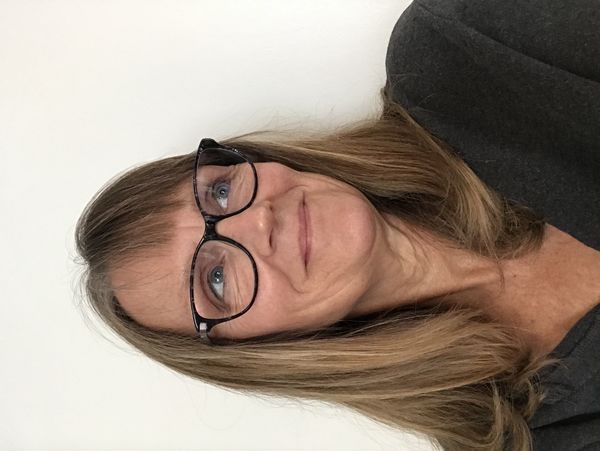
Author Nancy Hundal. A woman with straight, light brown hair and glasses smiles softly while looking slightly to the side. She is wearing a dark gray top and is posed against a plain white background.
OB:
What’s your favourite part of the life cycle of a book? What’s the toughest part?
NH:
One of my favourite parts is having the completed book in my hands for the first time. Often I’ve seen the illustrator’s work before then, but it’s different looking at online artwork marked up with notes for changes or text. When the finished book arrives, I love seeing how the words and pictures enhance each other.
Over the years, I’ve been so lucky to be paired with amazing illustrators, so my experience of seeing my manuscript interpreted through images has been a uniformly wonderful one. The toughest part is actually starting to write. I do research first and think about possibilities, but that moment when the story truly begins—choosing perspective, opening line, and where to start—feels momentous and sometimes hard to reverse.
OB:
What are you working on now?
NH:
I have a couple of projects on the go. I’m working on the pre-publication steps of a picture book about homing pigeons. It’s based on the fact that my dad had homing pigeons as pets when he was a child around the time of the Second World War, when these birds were widely used as messengers.
I’m also working on a few other picture book manuscripts in early stages, including one about a “papergirl”—a female version of the paperboys who used to race through neighbourhoods on their bikes, tossing newspapers onto porches.
_____________________________________
Nancy Hundal is a celebrated children’s author and retired teacher-librarian from Vancouver, British Columbia. Her writing is inspired by all the great kids in her life, past and present. She lives on the beautiful West Coast she’s been fortunate to call home her whole life.
Ellen Rooney has illustrated more than a dozen picture books, including A Park Connects Us and What to Bring, and likes to create colourful textures to use in her art. Ellen lives in British Columbia’s Okanagan Valley. She loves to hear the birds outside her studio singing while she works.