KidLit Convos! Jean E. Pendziwol & Risa Hugo Dig Into THE QUIET HUNT: A POEM FOR YOUNG FORAGERS
In The Quiet Hunt (Groundwood Books), the search for food doesn't begin in a grocery store, but rather outdoors, where patience and attention matter most. The story invites young readers to notice what grows wild and freely, and to see gathering not as taking, but as participating in a long tradition of care.
Moving between the past and present, the book reflects on how earlier generations understood the land as a provider and teacher. Harvesting meant observing seasons, respecting yield limits, and recognizing that people are part of an ecosystem, not separate from it. That message still has profound meaning today, whether in a forest clearing or a patch of green tucked behind an apartment building.
Written by Jean E. Pendziwol, whose work often centres quiet encounters with the natural world, and illustrated by Risa Hugo, the book pairs thoughtful language with textured, evocative art. The Quiet Hunt encourages children to look closely, tread lightly, and discover that stewardship can begin right outside their own door.
Check out this KidLit Convo with the author and illustrator of this amazing new book, where they talk to each other about the story and creative process!
Risa Hugo:
What was the strangest or most memorable part of creating this book for you?
Jean E. Pendziwol:
It isn’t strange so much as notable that this is a book I initially resisted writing. My agent, Olga Filina, and I were having a conversation that wandered toward foraging — I was probably telling her about my adventures blueberry picking — and she suggested it would make a wonderful children’s book.
My first reaction was a hard no. I didn’t want to write anything that might encourage kids to pick plants and put them in their mouths. But the more I thought about it, the more I realized the book didn’t need to be a “how-to” book — it could be a “why” book instead.
Foraging has always been part of my life and adds another meaningful layer to my experience of being outdoors and engaging with the natural world. Once I embraced the idea of celebrating our ancestors who gathered food and considered the importance of encouraging kids today to connect with their environments and the world that feeds them, I felt compelled to create it. I’m so happy I did. It’s become a love letter to the natural world.
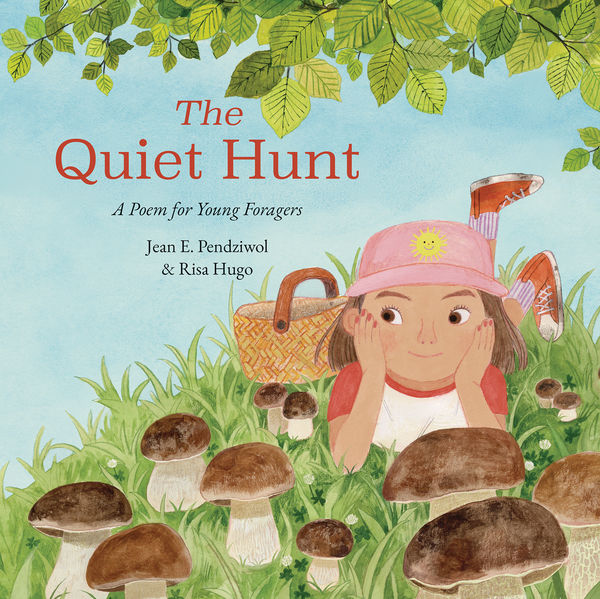
The Quiet Hunt - A Poem for Young Foragers by Jean E. Pendziwol and Risa Hugo
JEP:
What do you hope young readers will take away from our book?
Your CanLit News
Subscribe to Open Book’s newsletter to get local book events, literary content, writing tips, and more in your inbox
RH:
As a child, I loved picking flowers and berries on my way home from school. I believe my grandmother first told me about the flowers, and my brother and I would always collect a few to taste. My grandparents also shared stories about the plants they foraged during the war.
While researching for this book, I discovered that the white flower I used to suck syrup from is called Japanese honeysuckle. When I last visited that road, it had been completely paved. It’s fascinating how much the environment has changed for kids these days.
While I don’t want children picking random mushrooms or berries and eating them, I do believe there’s something special about tasting something like that in a safe environment. I hope this book sparks their curiosity and encourages them to spend more time outdoors. I also hope it prompts them to think about what foraging meant to our ancestors. What I enjoyed as a child for fun was a necessity for my grandparents.
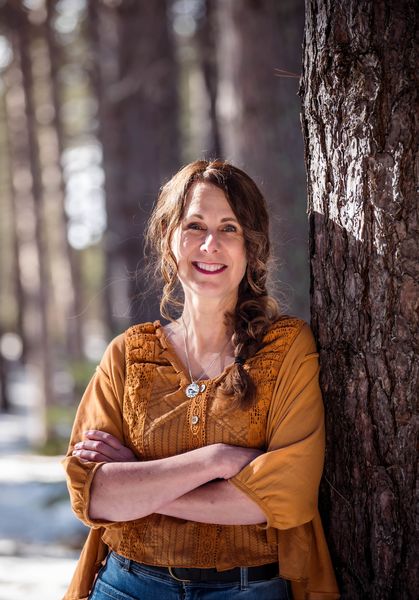
Jean E. Pendziwol (Photo by Ryan Wilkie, Dark Forest Photographic)
RH:
What was your workspace like while working on this book? What do you need in order to make a work session successful?
JEP:
I’ve only had dedicated office space for the past few years. Before that, my writing took place wherever and whenever I found the time and space to work. I love my office — it’s full of artwork from previous picture books, collections of rocks and feathers, a whole lot of foxes (from mugs to ornaments to stuffed animals), books and research files, a chart of Lake Superior, a standing desk my husband built for me, and an ergonomic chair.
So where did I write this book, and most of my other work? On the sofa in front of the fire, with a latte or mug of tea, feet tucked up, computer on my lap. Please don’t tell my physiotherapist.
JEP:
What was your workspace like?
RH:
Messy! Honestly, that’s not unusual for me. I tend to leave everything I need on my desk and surround myself with creative chaos. My desktop computer was open with numerous tabs about different cultures, reference photos, and even the National Geographic YouTube channel.
I spent most of my time researching various cultures and their diets. To illustrate this book the way I envisioned it, I needed to understand our ancestors’ diets and what grew in different regions. My editor, Samantha, also helped me a lot in finding interesting cultures and plants to explore.
I also take lots of breaks when I’m illustrating. I realized my concentration lasts about two hours, so when I notice I’m getting distracted, I’ll walk around, work on a knitting project, or go outside to play with my dog. Fortunately (or unfortunately!) one of my kids is usually interrupting me when I’m working, so I don’t have to plan those breaks too carefully.
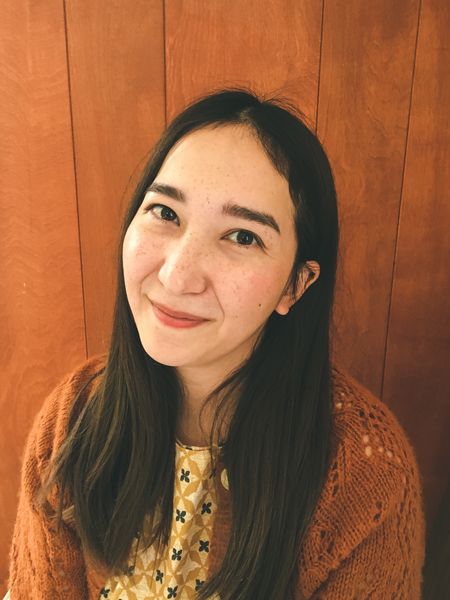
Risa Hugo.
RH:
Is there anything else you’d like to share about your experience working on this book?
JEP:
Sometimes the title of a book arrives before the story itself, and that’s what happened here. Years ago, before this story-poem was even a seed — or a spore — I heard the term “mushroom hunters” used to describe our ancestors, predominantly women and children, who gathered food.
It led me to explore the idea of a quiet hunt, a phrase used by some writers to describe foraging. I loved that concept. We often get caught up in the thrill of animal hunts and forget that quiet hunters acquired and passed down a wealth of knowledge across generations.
Using The Quiet Hunt as the title is my way of honouring the important and often overlooked role our female ancestors played in feeding their families.
JEP:
What advice would you give to someone working with a co-creator on a book for the first time?
RH:
Be yourself. You were chosen for a reason, so trust that instinct. And for me, if I can immediately visualize images while reading the story, that’s always a good sign. It means I’m connecting with the narrative — and that connection is what makes collaboration successful.
__________________________________
Jean E. Pendziwol's highly acclaimed picture books include When I Listen to Silence, illustrated by Carmen Mok; I Found Hope in a Cherry Tree, illustrated by Nathalie Dion; Me and You and the Red Canoe, illustrated by Phil; and Once Upon a Northern Night, illustrated by Isabelle Arsenault (finalist for the Governor General’s Literary Award and the TD Canadian Children’s Literature Award). She lives in Northwestern Ontario on the shores of Lake Superior.
Risa Hugo is an illustrator whose picture books include Why Are You So Quiet?, written by Jaclyn Desforges; Leopold's Leotard, written by Rhiannon Wallace; Métis Like Me, written by Tasha Hilderman; and Shadow, her authorial debut. Risa has a Bachelor of Fine Arts from Emily Carr University of Art and Design. She spent most of her childhood living between Canada and Japan, and currently lives on a small farm located in the Southern interior of BC with her husband and three sons.