Read an Excerpt from KARAIKHOLA FLOWS, the Exciting Debut Poetry Collection by Saraswoti Lamichhane
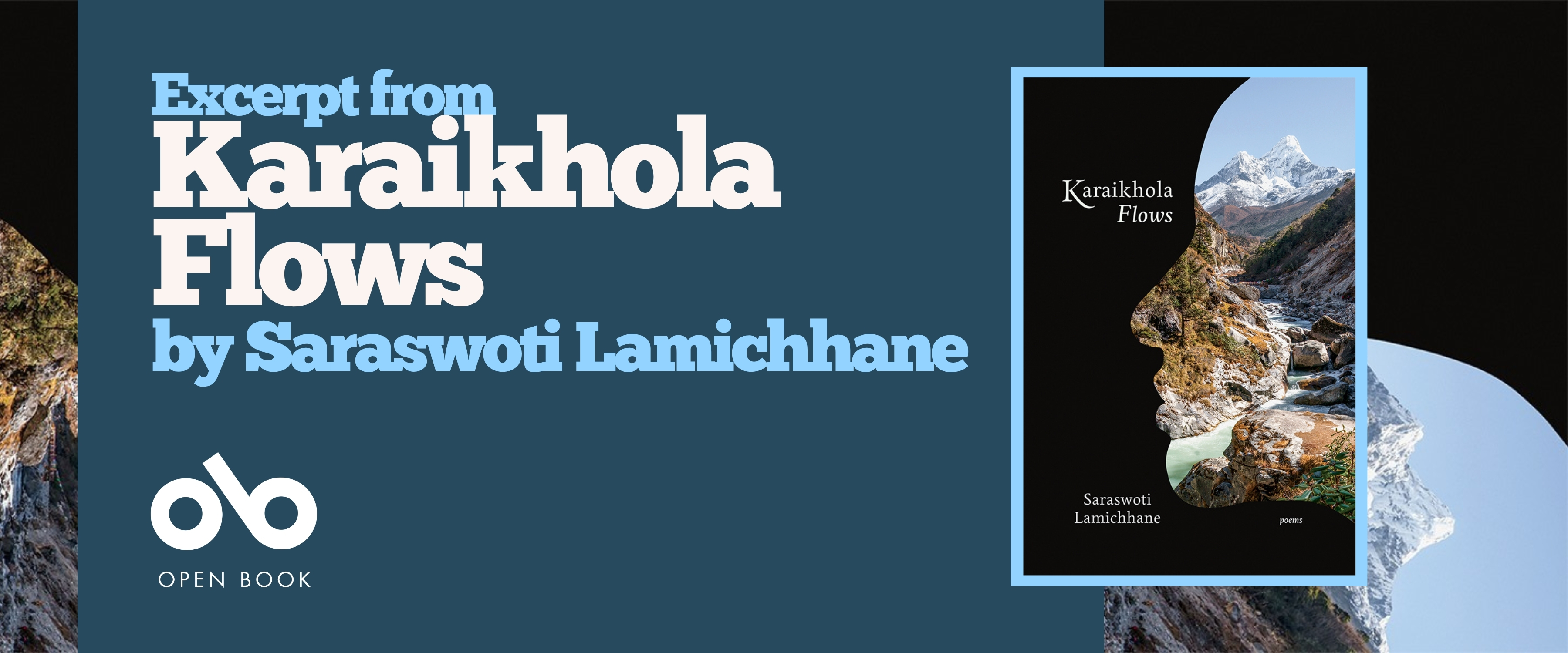
In Karaikhola Flows (Mawenzi House), Saraswoti Lamichhane intimately explores Himalayan village life, tracing how education, migration, and tradition reshape what is possible, especially for women.
The poems move through daily realities and the larger pressures in life, from intergenerational change to the limits placed on women’s bodies and movement. Some speak to freedom and learning, others to harsher conditions, including child marriage, trafficking, and the lasting effects of political conflict. Throughout, the land remains central, not just as a place to settle in, but as something lived with, depended on, and understood in profound and varied ways.
Lamichhane keeps the focus on lived experience while also reaching further outward, offering a point of connection for readers beyond Nepal. Karaikhola Flows reflects on belonging, movement, and what it means to carry one place into another, while keeping women’s voices and perspectives firmly at the centre.
We've got an excerpt from this exciting and assured debut to share with our readers right here!
An Excerpt from Karaikhola Flows, the Debut Poetry Collection by Saraswoti Lamichhane
Preface
The Karaikhola River gives its name to a village in Nepal’s western hills. The river’s story begins with Buwa, my father. After selling his property to build a school, Buwa moved from a nearby valley to the Karaikhola’s slopes. He found himself surrounded by the bald hills, raked by the landslides that had swallowed whole houses. The river was dry, except during the rainy season.
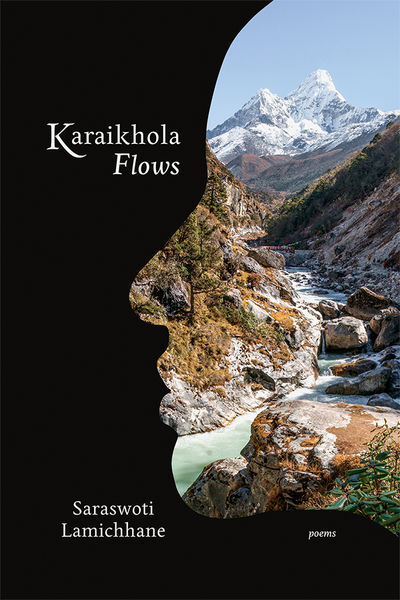
Karaikhola Flows by Saraswoti Lamichhane
He began his solo afforestation campaign. For years he performed his dharma, tirelessly nursing the saplings until the soil began to hold. When the trees grew into a forest, the river started to flow year-round. When the forest became denser, the river swelled, and the currents grew stronger.
When I was born, the earth around us was green. For fifteen years, I slept with my doors open, listening to the river. She was the constant background noise that rocked me to sleep. I knew her from within: I was swimming in her currents and learning the rhythms of the smooth and jagged rocks that lined her bed; the little fish darting in the clear pools and crabs scuttling under the stones.
I explored the land surrounding the river through taste, foraging for the sweet, sticky nectar of chiuri and madane blossoms. Nobody else roamed alone in the forest as I did for over a decade. I was the only human privileged to experience the forest this way. I learned about trees by climbing them, learned the feel of their bark and seeing the world from a branch’s cradle. I saw birds and animals from neighbouring forests arrive, making homes in the wilderness. There were the occasional visitors—the playful monkeys and the fierce, majestic tigers.
Then the civil war began. The Nepali Maoist rebels brought chaos and insurgency to the village. Sanskrit books were burned, schools were closed, teachers and elders were killed, and young adults were forcibly recruited to join them. Doors had to be locked. The silence that followed was of a different kind. Karaikhola browned with the monsoon rage; in other seasons, she whispered secrets under her surface. I learned the river’s way: to flow beneath the sand, only to reappear further down. I carry this river in the creek on my back. I practise embodying her flow—her calm, her songs, her hiding, her appearing, and her muddy, raging floods.
Your CanLit News
Subscribe to Open Book’s newsletter to get local book events, literary content, writing tips, and more in your inbox
I now live by the Sturgeon River in Alberta and wait for the ducks every spring. I walk along the North Saskatchewan River in Edmonton. The glacial water misting above the Athabasca River—this precipitation high in the atmosphere has no name. All these rivers carry the same current. It is one water the earth contains in various forms; the flow is the same. The poems in this book are about the leaves, the rocks, and the drifts that Karaikhola carries in her currents.
Birth Story
Mother pushes. Her howl calls
my birth in the kitchen corner.
Warm July rain roars
a rigorous beating
on the tin roof, on the corn leaves,
surging melodies through the passage
to the river, to the ridgetop,
and my arrival
a song to the earth, my auditorium.
When news reaches the rice terrace,
it becomes energy.
A renaissance rises among the planters.
Plowmen suddenly swarm with saplings,
and the mud show soaks
them all in celebration.
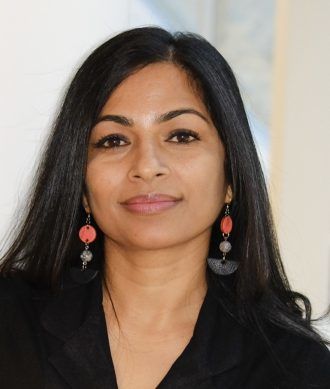
Saraswoti Lamichhane
Given to the Wilderness
Every pine I hug is a mother.
Some old cones fall from the branch,
slicing the silence; joy spills out.
It’s getting dark, but my mother is not worried.
She shared me with this land, a long time ago.
I gave her to the wilderness, she often says,
as she sees me racing to the summit,
crest of the lonely tree. My little legs spiral downhill,
arms wing wide and my face whips against the wind.
And I know I am becoming a disciple
of little things, of an unending expanse
that I begin to mother.
Those were the years I slept with the house doors open.
Then the Maoists came,
and I shut my door to the darkness.
A young boy once ran across the hill—
he was fighting for the country.
I was up in a tree fort, reading stories,
when he lobbed the bomb towards the military base
on the other side of the mountain,
and ran back straight down
the wall of the hill, petrified. I held my breath,
his every step my later nightmares
and I know this:
sometimes it takes years for the night to fall
because my soul needs a forest big enough
to feel safe in the thick of the woods.
___________________________________
Saraswoti Lamichhane is a life celebrator who honours the earth. Her work is influenced by landscape and life. She is a co-author of Six Strings: A Joint Anthology of Poems, and her work appears in various anthologies, including Of Nepalese Clay, the Stroll of Poets, and Outlying Voices, and in journals in the USA, Canada, UK, India and Nepal. She holds a Bachelor’s degree from Tribhuvan University and a Master’s degree from Pokhara University. Sara has a certificate from the Creative Writing program at the University of Toronto. She has lived in Nepal and Toronto, and now calls St. Albert, Alberta, home.
Kevin Hardcastle is a fiction writer from Simcoe County, Ontario. He studied writing at the University of Toronto and at Cardiff University. His work has been widely published in journals including The New Quarterly, The Malahat Review, Joyland, Shenandoah and The Walrus. Hardcastle was a finalist for the 2012 Journey Prize, and his short fiction has been anthologized in The Journey Prize Stories 24 & 26, Best Canadian Stories 15, and Internazionale.
Hardcastle’s debut short story collection, Debris, was published by Biblioasis in 2015. Debris won the 2016 Trillium Book Award, the 2016 ReLit Award for Short Fiction, was runner-up for the 2016 Danuta Gleed Literary Award, and was a finalist for the Kobo Emerging Writer Prize.
His novel, In the Cage, will be published by Biblioasis in Fall 2017.