Christine Quintana's AS ABOVE Finds Connection in Unexpected Places
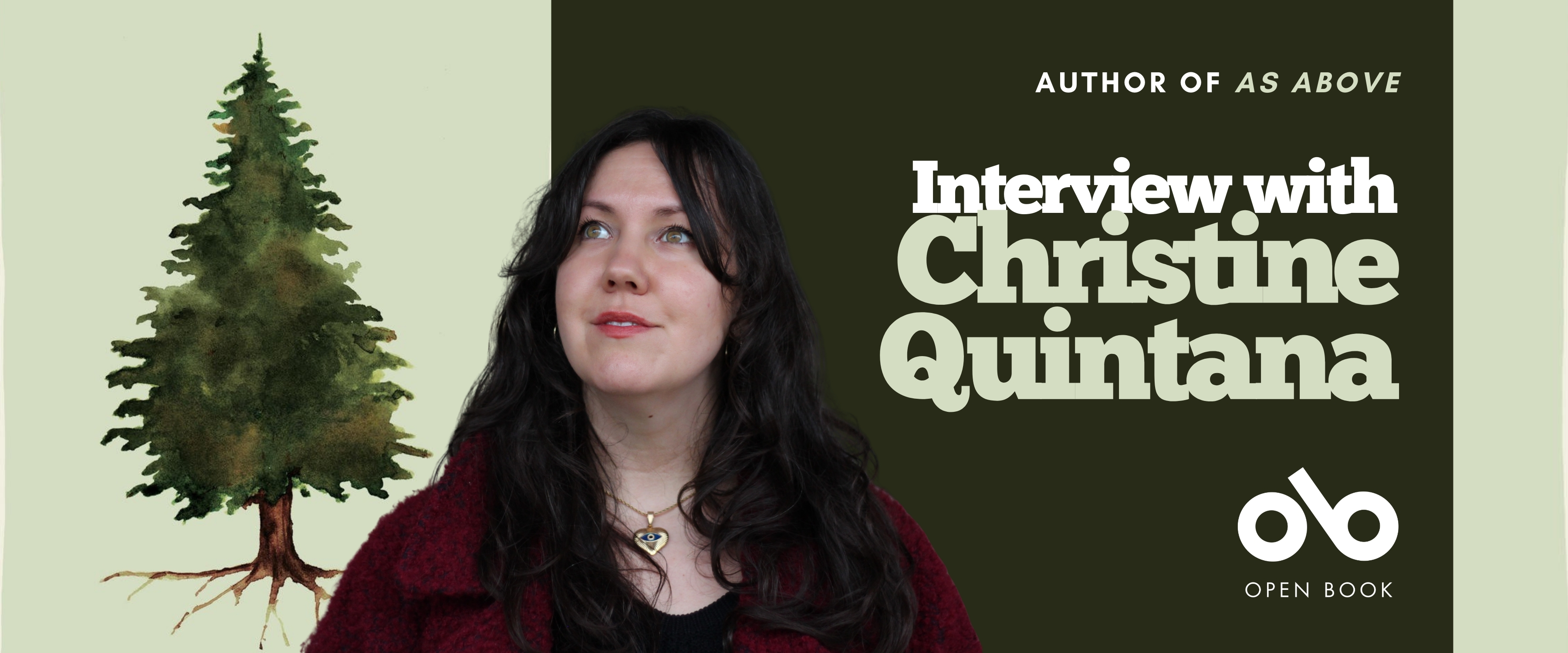
In our featured title today, As Above (Playwrights Canada Press) A woman in recovery tries to rebuild a life shaped by loss, regret, and long-held silence. Jo is in her sixties, newly sober, and far from the career she once had as a respected botanical researcher. Teaching classes at a local horticultural centre, she moves carefully through her days, forming tentative connections, including a growing bond with Rick, another recovering alcoholic who understands how fragile progress can be. When an unexpected call from her estranged daughter pulls Jo back toward unresolved pain, she sets out on a difficult journey through reckoning and repair, guided by her deep attention to the natural world around her.
Acclaimed actor, playwright, producer, and dramaturg Christine Quintana weaves a quiet, emotionally rich story set among the cedar forests of Victoria, British Columbia. The play explores how healing can unfold slowly, through patience, listening, and the often unseen ways people and environments communicate. Rooted in care for both human and nonhuman life, it is a thoughtful meditation on recovery, connection, and the courage it takes to reach toward what feels broken.
Go Behind the Curtain in this playwrights interview with the creator of this captivating work, right here on Open Book!
Open Book:
How did this play first come to life for you? Do you remember the first bit of writing you did for it?
Christine Quintana:
I will never quite forget the genesis of this particular play, because it was the most instant and most complete idea that has ever arrived for me. In a single moment—randomly standing in an art gallery—the entire story arrived in one burst. Usually my plays are the result of many months or years of thinking, considering, and turning ideas over and over in my head.
This one felt like it was given to me, whole, to write. My resistance to accrediting this to some sort of divine intervention is mirrored very much by Jo’s resistance, in the play, to entertaining the idea of a higher power that may be guiding her. I don’t understand how it happened, but I’m deeply grateful for it.
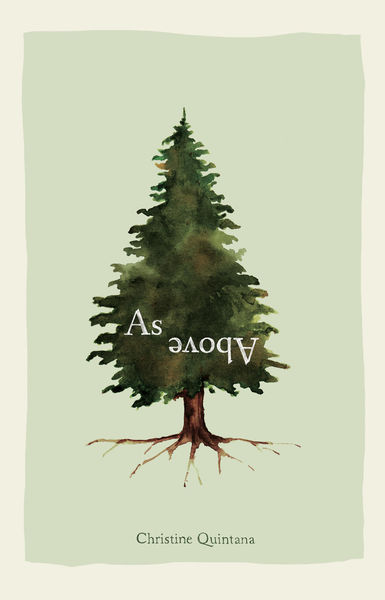
As Above by Christine Quintana
OB:
Was there a question you were exploring in this work, and if so, did you know what it was when you started writing?
CQ:
I heard an interview with superstar Canadian scientist Dr. Suzanne Simard on Radiolab about the growing body of research suggesting that trees and other plants “talk” to each other. I was amazed by the idea of these invisible points of connection beneath our feet, all around us, and by the deep links between trees, fungi, and the plants and animals that surround them.
I’m also deeply interested in how addiction affects our communities, and how, at the core of addiction, is a lack of connection. I’m far from the first to make the link between wellness and interconnection with the natural world, but I was very interested in embodying those relationships through the characters of As Above, and in imagining a woman finding her healing path through her lifelong connection with the forests she loves.
Your CanLit News
Subscribe to Open Book’s newsletter to get local book events, literary content, writing tips, and more in your inbox
OB:
What drew you to the setting of your play, and how did you go about creating it?
CQ:
When I first began writing this play as a commission from the Belfry Theatre in Victoria, BC, it was set in Toronto. I initially felt the urban crush of the Big Smoke was a perfect place to explore feelings of disconnection, but I was struggling to animate and give life to the depictions of the natural world that are so central to the play.
I had invited Tasha Faye Evans, a Coast Salish artist and friend, into my process as a cultural dramaturg, and she encouraged me to relocate the play to lands that I knew and felt connected to. She noticed that through my attempts to write about the deciduous trees of Ontario, I was really speaking, in my heart, about the precious cedars of Coast Salish territories. Once I changed the setting to Victoria itself, the whole world of the play opened up to me.
OB:
Do you have a community as a playwright? If so, tell us a little bit about how you found them and the role they play in your writing.
CQ:
I’m grateful to have a large and extended community as a playwright—from the folks at the Belfry who supported the creation of this play, to my actor friends who came over to read drafts in my living room, to the scientists at the Mother Tree Project who helped me research and fact-check, to the powerhouse Meg Roe who directed the premiere production.
But for me, the most precious community in my playwriting circle is theatre audiences. I wrote this play with an older woman at its center because women are always the majority of the theatre-going community, yet they are so rarely depicted with complexity and respect on stage. I worked in theatre box offices for many years and watched hundreds of women organize their families, friends, spouses, and kids to get to the theatre—yet women their own age were rarely given the spotlight.
I was profoundly moved by the dozens of emails and notes we received during the run of As Above from women Jo’s age who felt seen and respected—who loved seeing a woman who falls in love, ruins her life, and gets a second chance. I was approached by a woman at a talkback who thanked the play for helping her see herself as more than solely the mother of an addict, but as someone with a whole forest of stories of her own. I’ll remember that forever, and I will never forget to put theatre audiences and readers at the center of my artistic community.
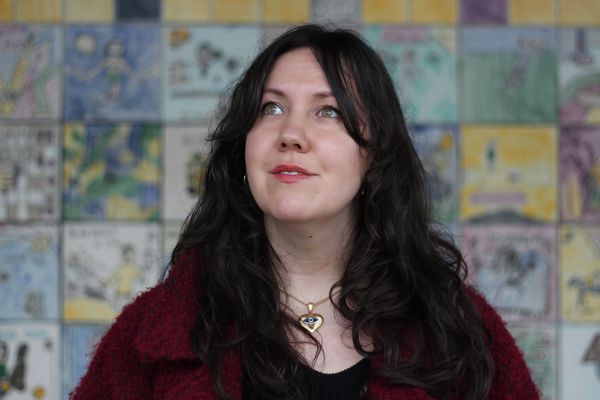
Christine Quintana
OB:
How would you define the role of theatre in society?
CQ:
A major throughline of As Above is recovery from addiction, and in the story Jo and Rick are both attendees of Alcoholics Anonymous. From my research and from the generous sharing of those involved, I understand the core tenet of AA to be connection: you have somewhere to be, people who expect you there, and something to do when you arrive. That regularity becomes an anchor in the lives of people seeking recovery in a fragmented and isolating world. AA also closely resembles a place of worship, with its ritual and shared values.
In our secular, fragmented world, I believe theatre shares a role with these spaces as a “third space”—a place to come together with friends, neighbors, and strangers to engage in ritual and to feel connected to something greater. To understand the world through the stories of others. Theatre is as imperfect, frustrating, and elusive as these other spaces, but it has persevered all the same.
I sometimes get the same feeling stepping into a theatre as I do stepping into a forest: awe, connection, gratitude. It’s the same feeling some may experience stepping into AA, a place of worship, an ice rink, or jumping into the ocean—to surrender, for a moment, to a higher power reflected in the life around us.
_________________________________
Born in Los Angeles to a Mexican American father and a Dutch British Canadian mother, Christine Quintana is now a grateful visitor to the unceded lands of the Musqueam, Squamish, and Tsleil-Waututh people. Christine is an actor, playwright, producer, and dramaturg. Nominated for a Governor General’s Literary Award and winner of an LA Drama Critics Circle Award, a Dora Mavor Moore Award, a Jessie Richardson Theatre Award, the Tom Hendry Award, and the Siminovitch Protégé Prize, Christine’s works have been translated and performed in Spanish, French, German, and ASL in over ten cities worldwide. As a performer, she’s acted on stages big and small, in a camper van, in neighbourhoods across East Vancouver, and on a farm. Christine is a graduate of UBC’s BFA Acting Program.