Read an Excerpt from CAN POSTERS KILL? by Jerry Faivish (with Kathryn Cole)
Propaganda shapes people’s beliefs in ways that are often hard to see until long after the damage is done. The featured book today, Can Posters Kill? (Second Story Press), looks at how hateful messages were crafted and circulated over centuries and how they eventually helped the Nazi regime make mass violence seem acceptable. Through a close look at rare posters, it shows how simple images and repeated slogans can stir strong emotions and steer public opinion.
Storyteller, educator, and cultural expert Jerry Faivish brings these materials together to help readers understand how visual messaging works and why it still matters. By looking clearly at the past, this crucial book offers tools for recognizing and resisting harmful narratives in today’s fast-moving digital world.
We're honoured to share an excerpt from this important work on nonfiction on Open Book for all of our readers. Check it out here!
Can Posters Kill? by Jerry Faivish (with Kathryn Cole)
An Excerpt from CAN POSTERS KILL by Jerry Faivish (with Kathryn Cole):
Pre–World War II Posters: 1933–1939
Introduction
Posters from 1933 to 1939 generally reflect the work of Hitler’s newly formed Ministry of Propaganda. The posters blatantly emphasized the long arm of the Nazi Party. The status and resources given by the government to promote the Nazi antisemitic agenda became more apparent as Hitler’s power increased. In 1928, Hitler appointed Paul Joseph Goebbels, already the district leader of the Nazi Party in Berlin, as the propaganda director for Germany. The ministry of propaganda also had the seal of government approval in places Germany annexed or controlled, such as Austria and Czechoslovakia. Posters were often grouped together in themes or styles: newspaper posters and cartoons, antisemitic caricatures depicting Jews as calculating and greedy, and portrayal of Jews as power-hungry threats to the Aryan race. As Goebbels succeeded, his power grew along with Hitler’s, and soon he had control of radio, the press, the arts (including literature), stage and film productions, fine art, and even music.
Can Posters Kill? by Jerry Faivish - Pre–World War II Poster
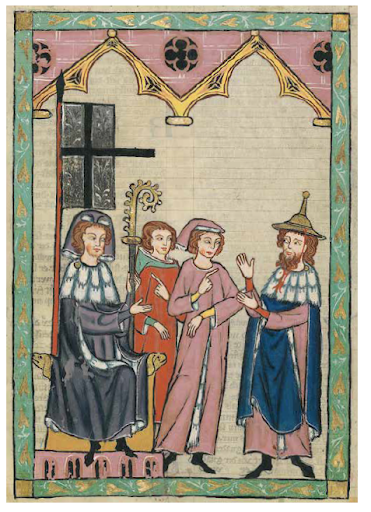
Although this image is not a poster, it is evidence of the very long-standing practice of identifying and isolating Jews from the general population. Antisemitism goes way back to ancient times, but this is a painting from the Medieval period. It reflects the laws that were put in place to brand Jews as outsiders. The man on the right is being forced to wear specific clothing that tells others he is a Jew—a person with restricted freedoms. Jewish people were required to wear an identifying badge and hat so they could easily be spotted and prevented from owning land, joining mostly Christian craft guilds, and finding ways to prosper.
The Nazis reintroduced this centuries-old identification policy before and during World War II by making it mandatory for Jews to wear a yellow Star of David. Relatively few people who didn’t look Jewish and refused to sew the star badge on their clothing managed to avoid the law and escape. For the most part, the traditional identification rules worked effectively—but not in Nazi-occupied Denmark. Most of the Danish Jewish population survived because there, wearing the yellow star was not required, and laws against them were not enforced. They had support from their king, government, and countrymen. There is even a legend that King Christian of Denmark himself wore the Star of David in solidarity with his Jewish subjects, but that is apparently not true. However, in 1943, with his knowledge and the help of Danish citizens, about seven thousand Jews were hidden or spirited away on all types of boats that carried them to safety in neutral Sweden.
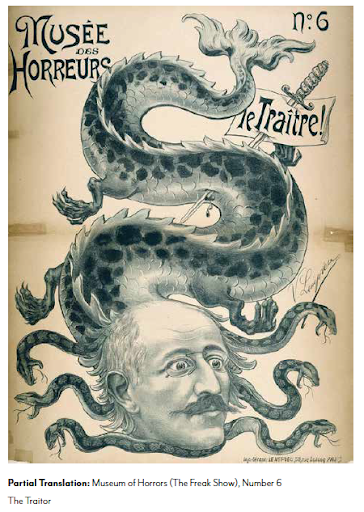
Can Posters Kill? by Jerry Faivish - Propaganda Poster
To understand this antisemitic poster, we must go back to France, 1894, when something called the Dreyfus Affair began. It caused great division in the country and continued until 1906, when the issue was finally resolved.
Alfred Dreyfus, a captain in the French army, was wrongfully accused of giving French military secrets to the Germans. Because he was Jewish, the people against Dreyfus found it easy to blend the words traitor and Jew together in an effort to stir up anger against him. Upon his conviction for treason, Dreyfus spent five years of his sentence in a penal colony on Devil’s Island, aptly named for its terrible conditions.
But Dreyfus supporters remained active. One of them, Lieutenant Colonel Georges Picquart, uncovered the real culprit and presented his evidence to military officials. Perhaps because they wanted to avoid scandal and/or were antisemites, they immediately concealed the evidence and even added more charges against Dreyfus! Opposing newspapers chose sides, but gradually public opinion for Dreyfus improved, as did the demand for justice. He was returned to France, and after more twists and turns, his conviction was overturned. But the affair left France deeply divided, with antisemitism much stronger than before.
This antisemitic poster is the sixth in a series that represents Dreyfus and his supporters as grotesque animals. Here, a hydra, or multiheaded serpent, squirms as it’s punctured by a sword declaring it a traitor. In Greek mythology, if a hydra’s head was severed from its body, two more grew in its place. This serpent bears Dreyfus’s likeness and the inference is clear; the Jews are doubling in power even as we try to stop them. Snakes, age-old symbols of evil, writhe and strike out at all that is good. As you will see later, snakes became a popular tool used by Nazis to promote negative feelings toward Jewish people.
Your CanLit News
Subscribe to Open Book’s newsletter to get local book events, literary content, writing tips, and more in your inbox

Jerry Faivish (Photo by Sonya Kaplan Photography)
______________________________________________
Jerry Faivish has always been a storyteller — with his friends and family, through his vast collection of Jewish-themed posters, or with his renowned jokes. Practicing law for 45 years, he also dedicated himself to preserving Jewish history and culture, a passion sparked when, as a young man in Tel Aviv, he saw posters being covered up layer upon layer and decided to collect them. Born in Montreal to Holocaust survivors, Jerry has since shared his collection with audiences around the world, from Jerusalem to Florida and New York, with notable exhibits at the Steven Spielberg Film Archives and as part of a US tour organized by Project Judaica.
Kathryn Cole has spent her career in children’s books as an illustrator, art director, editor, designer, instructor, and publisher at Scholastic, OUP, Stoddart Kids, Tundra Books, and Second Story Press. The books she has overseen have won multiple awards, including four Governor General’s Awards and the Bologna Ragazzi Award for Nonfiction. She has authored nine books including Double Take: a Single Woman’s Journey to Motherhood. Kathryn volunteered as a support to parents for thirteen years with Boost in their crisis support and court preparation groups. She lives in Toronto where she enjoys freelancing as a consultant, writer, and editor.